Wednesday, 30 January 2008

How to survive in Venice: a handy guide for ignorant foreigners


There are some basic rules to visiting that place. I will put them in a row one by one to avoid the vague musings that might come out otherwise (see below what happened last time I tried to write about Venice).

1. Drop your ideals in a bin. This is not a dream city. It is a city. Think what you want of it, but you can be sure that the houses are not really made of gold, nobody really uses the gondolas to get around and the gondolieri will never, and I mean never sing O Sole Mio to you while you glide romantically down the canal at sunset.

2. Want to eat? Get as far away from St Mark's square as you can. West, if possible. There are some reasonable bars off the tourist centre, and, if you're lucky, you might find a few of the well-hidden supermarkets too. In any case avoid the restaurants where slick English-speaking young men offer you a fixed price deal at the front door.

Also, there is a strict rhythm and unimaginable amounts of unwritten rules to eating in Italy. The rhythm is easy enough:

- morning - 10.30/11.00: breakfast: cappuccino and a croissant or cookies usually. In any case NOT a ham sandwich or scrambled eggs. This doesn't mean you're not allowed to munch on a sausage in your hotel room... if you really want to.
- 11.00 - 12.30/13.00: aperitifs: white wine, Prosecco or Spritz. You can skip that one, but you'll definitely see groups of senior gentlemen at it in small around-the-corner bars.
- 13.00 - 14.30: LUNCH. This is important, because after 3 o'clock you'll have trouble finding a local-oriented restaurant that will serve you more than a tiny sandwich. Also, lunch is the most important meal of the day for several reasons. Mostly, you'll note, because of your Italian-style one-biscuit breakfast you'll be starving by that time. A full lunch is 3 courses: primo (pasta, soup or rice), secondo (meat or fish) and dessert or fruit, though precious few people eat a full lunch out. Get a first dish, they cost less.
- 14.00/14.30 - 15.30: digesting. Venetians return to work. (South Italy prepares to eat.) There is no siesta as such in the North. In small towns where people return home to eat (and depending on the nature of their work) the lunch break can stretch from midday to 3 pm, in which case the working day finishes around 7 in the evening.
- 16.00: you can think about a little merendina, a snack. Still no restaurants serving food.
- 18.30 - 20.00: aperitifs*. This time it's serious. You should get one. Or two.
- 19.30 - 21.30: dinner. This is when people really go out to eat. Also, single-course meals such as pizza or bruschette are only acceptable for dinner, so take your chance. Eating dinner out will invariably cost you a coperto, too (see below).
- 23.00 or before bed: herb tea or hot milk.

That much about the rhythm... the rules are a little more complex, but just don't order cappuccino after midday, don't put parmesan on seafood and you'll be fine.

3. Want to drink? Same thing: get away from San Marco. You might be tempted by Caffé Florian, the very first cafeteria to open in Europe (1720), or another of the fancy places right at the square, but enter at your own risk. The coffee will cost you 5, the milk in it 2, the chair 3 and the music 5 euros or so. In a normal bar the price of an espresso is fixed to 0.85 - 1 euro. Wine should also be ordered with care, though the presence and concentration of tourists at any given place is usually an indicator of the fairness of the prices. By the way, wine is always connected to food in Italy, so drinking as the North does - just for the fun of pouring it down - is incomprehensible; getting drunk during dinner is embarrassing. (This doesn't mean the Italians don't have their fun though.)

4. Sitting down. Remember that the chairs will cost you. There is such a thing as coperto in the Italian restaurants that literally means "covered" and is indeed a quite obscure addition to any restaurant bill. Technically it is simply service charge. It solves a lot of problems, such as ethical (for you: deciding whether and how much to tip) and financial (um... for the restaurant owner). Coperto usually ranges from 1.50 to 2 euros, but in Venice it has been developed to an art form (see previous rule). Thus, when the barman smiles at you nicely and asks you to sit down, be wary and try to get a look at the menu first: the coperto will be written in tiny letters at the bottom of the second page. Some restaurants are honest enough and write down their "bar" and "table" prices outside - they will differ considerably. In the more tranquil areas of Venice the coperto will probably not be an issue and is applied only when you eat and are served at the table (in other words, in a situation where you might consider tipping in other countries). You shouldn't, in theory, be asked to pay for service if you have simply rested your left buttock on a chair for five minutes while eating a sandwich or drinking an aperitif.

5. Forget the gondolas. The guys who row people around in them are already so rich they couldn't care less if you get your romantic ride on the Gran Canale or not. One ride costs 80 euros and, accordingly, 8 normal-weight people are able to squeeze inside. If you have your mind set on crossing the Gran Canale though (best views in town!), you can also get a traghetto (ferry) for 6 euros. The same price applies for most routes, including the surrounding islands.**

6. And finally: get lost. Prepare to walk considerable distances. It's the only way of discovering Venice, though in most cases getting lost is not completely voluntary. If you prefer knowing where you're going or steering steadily towards the train station to get away from the place, just follow the yellow signs above your head on strategic street corners. 'Ferrovia' stands for the train station. 'Rialto' stands for the Rialto bridge.


Good luck.


* It seems that aperitifs are such a very Veneto thing that going south it exists less and less. In Florence an aperitif means a snack buffet that costs accordingly.
** the 6-euro traghetto ticket costs 1 euro for Venetians and anyone resident in the region. Understandable, though a little harsh, just like everything that the tourists are expected to pay in Venice. Now they opened a locals-only line (nr 3). If you're turned back, it's because the Venetians are happy to separate themselves from chattering tourists groups. Well, we knew that already.

What is it that you want Venice to be?

There are hundreds and hundreds of well-meaning tourists stepping off trains and buses at Venice each day. They are hoping for... something extraordinary, at least, because it is Venice. They will be hard put to describe exactly what it is they are looking for, but it all has something to do with vague romance, the glory of times past and indescribable beauty. They think of the San Marco* square, of the gondolas and the Carnival**; but definitely not the pigeons, the restaurant prices or the hordes of other tourists looking for their fill of digital photos and tacky souvenirs.

Some are exhilarated, willing to suffer the minor inconveniences and pay the price, because of what Venice means: it's the crown jewel of every traveller, the perfect destination! Others are disappointed or confused. The unmistakable atmosphere of a cemetery is conspicuously present in the streets where every stone has been present for centuries. The density of people in the narrow streets of the tourist belt between the train station and San Marco will give claustrophobic attacks to contact-conscious Nordics. And then, of course, there is the obvious state of neglect into which the city has fallen in the last 200 years or more. It is this, more than anything else, what shocked me at first. La Serenissima, the beauty and the biggest maritime power of all the Mediterranean once, is feeding on the scraps of its glory - the decadent hotels, the murky green canals, the tourist traps. Is it true there are people still living here?

It turns out that there are. And they are not all gondolieri, either. There is life behind these dilapidated windows, though your average Venetian is heartily sick of the tourist groups that roam the streets and consider them not too different from the bands of pigeons ruining the city with their infested presence. Of course, Venetians have their own Venice, quite hidden from random eyes*. It is this city that is truly fascinating. It is possible to catch a glimpse if you wander off and find a fruit market.

I had to understand this idea of an alive Venice before I could appreciate the place. Then I could take it as it really was - alright, it's a little dirty, it's not perfect, but why should it be perfect? The would-be-romantic gondolieri who teach dirty songs to innocent Japanese are not much different from any guy around the world who rips tourists off for living: it does get dull after a while. It's even possible to avoid the crowds: I learned to walk the long way around.


* of course, often these photos of San Marco are made by professional photographers who have taken the trouble to get up at sunrise to get a shot at the square before the crowds start butting in. Beautiful, but unrealistic.
** Carnival is one of the most characteristic periods of the year for Venice and the mid-winter high season for the hotels, all for being able to see people in elaborate baroque costumes, wearing some of the traditional masks. Anyone looking to enter by train from the mainland will have to go through a compulsory all-body squeeze if they are to fit in the train at all.
* much like Tartu the university town and Tartu the normal town (mitteakadeemiline Tartu) exist in two parallel universes that rarely cross.

Friday, 25 January 2008

solidarity wow

The North and South of Italy are at it again: Naples is drowning in garbage and asking other regions to take in their stuff (to be disposed of 1000km from the original place? way to go...). Veneto has refused and not only - the region is financing TV spots in Germany, pointing out that Veneto is not Naples and there are no garbage issues in the North, so as to inform the tourists that otherwise would be scared into going to Spain instead*.

This shows some true Veneto spirit, I must say. In literature or drama, a stereotypical character speaking Venetian dialect is almost invariably a stingy merchant. It's not that far off - the people around here have always found a way to muddle through even in the worst of times and don't look well on others who don't seem to make as much effort. This is where the discord begins: in Venetian eyes the Neapolitans simply don't try hard enough. And when the president of the region is blamed of not being solidary, well, your average signor Toni will not care about not being nice: "Eloora, cosa xé che bisogna fare? Gà da svegliarse fora, no?**"

English Corriere della Sera on the matter

* I'll be thankful for a link to one of these clips. As of today none were to be found online.
** "So what's to it? Gotta snap ou' of it, yaknow..."

Thursday, 17 January 2008

Where am I?

I slept all the way through my flight and am consequently having trouble understanding where I am. I left the cold and gloomy Estonia only to arrive in cold, gloomy and wet Italy. Where are the benefits of the Mediterranean?

I'm also weighed down with a huge amount of materials on cross-cultural communication for my thesis, of which I will scorn some and apply others. It's a lot of fun, though it does make me think too much of anything the people say or do on the street: each action becomes an expression of underlying cultural values. I'll definitely be coming back to all that in the next months.


Estonia is strange in the winter, too. I had a little shock arriving, but got used to it quite fast and then it felt all sweet and homelike again. The truth is that though in the summer the life is beautiful and the Estonians become social enough to truly give Italians a run for their money, the winter is a depressive 8-month gloom. Some people shoot themselves when they can't face it anymore. Others, in order to survive, will construct a personal cocoon consisting of close friends and family, their favourite pubs, visits to the spa, homely tea rituals and simply shut out everything else as if it didn't exist (this is why nobody looks each other in the eye on the street). Occasionally the reality will catch up with them at the worst moments: at the 10 o'clock twilight of a a hung-over morning, or while carrying home heavy shopping bags in the perpetual darkness. At these moments the only thing to do is to pamper oneself, hoping that spring comes soon.

The Italians don't shut themselves away for the winter, though in clammy days like this one the piazzas stay empty and no-one feels like an aperitif. I'm feeling especially cocoon-like after my stint in the north and can't be convinced to leave the cosiness of my tea-cup and heater. Today, everything outside of home can wait for spring.

Saturday, 5 January 2008

Documentation

When my Italian friends see my Italian identity card, they are positively surprised: I didn't know they give these to foreigners too!

When my Estonian friends see my Italian identity card, they are surprised and say: but isn't Italy supposed to be a developed country?

My Italian identity card is made of paper.

It's nicely patterned, complete with gaps for hair colour, fingerprint and home address. But, effectively, yes, it's a piece of paper folded in soft plastic.

My Estonian identity card doesn't include any of this data, but does include a signature and a smart chip. The chip includes 3 library cards and can be used to sign documents and vote at a distance*.

The interesting part is that though the Italian ID card seems so unconvincing to foreigners, often it is the only identification that people have. Italians make a fuss each time they decide to travel outside the EU and have to apply and pay for a passport. Making a passport costs astronomic amounts of money and/or time. I've even heard of 70 euro for a passport if you want it faster than normal... seems like it might cost less on the black market.

I guess after a while Estonians won't be too attached to their passports either, as all the 10 EU member states who joined in 2004 are part of the Schengen area now. The land and sea borders are already open. The airports will adapt in the end of March when they change to summer season. That's quite convenient, though most of the border guards are relocated for different jobs and the only Estonian non-Schengen border (east; Russia) suddenly has a lot of guards. I do wonder what Czech Republic did with their border guards...


*
the voting business is theoretical - I missed the last referendum because I couldn't install the card reader driver on Linux. I hear it works though.

Wednesday, 2 January 2008

Natale 2

Second Christmas in Italy, and it was as Italian as expected: we decorated our 25-year-old Christmas tree up nicely, ate copious amounts of panettone and relaxed properly. But there's one thing that I still can't get used to - that's the social side of Christmas: the streets full of people and bars finishing all kinds of wine on Christmas Eve. Around here everyone just stays home with family or the respective boy/girlfriend and doesn't get out for seeing people before the 26th unless they're very close friends. In Italy, Christmas lunch is held with the immediate family and subsequent meals with various aunts and uncles, fitting a fair amount of friends and acquaintances in the middle. That's quite a run. Luckily I only have one family to visit. My feeling of being an inward northerner increased with each person Riccardo knew and congratulated. Well, the custom of giving the best wishes ("Auguri!") is usually accompanied by a handshake and this would be perfect for me. I like handshakes very much. Instead, because I'm a girl, I was expected to approach the people with each of my cheeks in turn and imitate kisses. This is an awkward business at the best of times, especially when both kissers wear glasses, but with people I had never seen before... difficult.

Any northerner who has been to Italy is probably quite familiar with the inner fight: is a friendly smile enough? should I shake hands? what if I'm supposed to actually touch faces? which cheek first?! An Englishman trying to go along with the most usual Italian hello-how-are-you kiss looks embarrassingly indecent: instead of performing with lukewarm/friendly affection they actually plant a furtive wet semi-erotic kiss on the cheeks of the unsuspecting Italian (almost always a woman) as though they had lost in the bottle game and had to do it on a dare. It would be funny if it wasn't so sad.

Hugging, the standard greeting in Estonia for friends, is a different issue. Italians might feel quite awkward if someone less than a very good friend would start hugging them all of a sudden. It's not easy to determine where are the limits of the various kinds of greetings, so the only foolproof way is to follow the locals. Lucky that Christmas is over...

Wednesday, 12 December 2007

The Alps are the limit

I went to Austria last weekend. It's strange to think that Innsbruck is only 4 hours away and I've never taken the chance. The difference between North Italy and Tirol was simply striking: just a few hours of driving had taken me to a place where it snows continually, people make gingerbreads for Christmas, use the sauna and eat heavy breakfasts. The fact that everyone was speaking rich Tirol-German didn't even seem to matter. I felt right at home. There is more cultural distance between Vicenza and Innsbruck than the latter and Tallinn. Who would have thought?

Or maybe I'm just homesick?

We stayed in a bed&breakfast at Seefeld. The house was exactly what one might expect, thinking of the Alps, Austria, the winter. Cosy. Breathtaking view all around. Interiours bordering on kitsch, but somehow sweet all the same with the endless teddy bears, doilies and Christmas decorations. It was almost hobbit-like with all the comfort and tranquility. We arrived late, so the landlady left the keys on the door for us. Just like that!

Here December doesn't mean snow, but fogs. I leave from Valdagno each morning with a clear blue sky and find a dense opaque wall of fog halfway down to the plains. Some of the evenings the visibility is so bad that the only reason I manage to weave my way through the twisting roads is that I know them by heart. Halfway back up again towards the mountains the fog disappears though, and the stars blink down in the cold night. But the winter in Italy is not gratifying. There are none of those rare evenings that make the Nordic winter worthwhile: the ones when it snows slowly and the quiet makes bitter people feel at peace with the world. Instead there are bright days, the bare trees full of persimmons like orange lamps and no real need for a woollen hat. That's obviously very nice, but all this, and the panettone or nativity scenes have nothing to do with Christmas in my mind. I need to stock up on other accessories, such as gingerbreads from IKEA...

I'll be landing in Tallinn at 16.00 on the 27th.

Tuesday, 16 October 2007

Two Italies

or: "Oh, that's all the way down in Terronia, that is..."

Estonia is a small country roughly the size of Denmark. It's possible to drive from one side of the mainland to another in 4 hours. The population is so small (1,4 million) that it is a piece of cake to set up complicated telecommunications-systems years ahead of other countries. Yet there are a few dialect areas and enough differences between different parts of the country to create a system of labelling - the islanders, the yuppies from Tallinn, the hippies from Tartu, the mulgid, the vòrokesed, the setod (the two latter ones have distinct dialects and traditions of their own). If this is possible in a country as small as this, what does it mean for Italy, long, mountainous and historically divided as it is?

Mostly it means that they have a hard time understanding each other. More specifically it means that for example:
- each small town competes with the other small town 10 km away - which is better, Valdagno or Schio?
- the next province is like another world: ah, the veronesi, they're all strange...*
- no-one likes the milanesi because they're city folk
- the north doesn't like the south because their economy is non-existent and they look lazy;
- the south dislikes the north because they work their life away and think themselves better because of it;
- the veneziani call everyone else land-folk, dirty shoes etc;
- the trentini aren't considered Italian as they're too far north;
- the sardi neither - they're too far from the mainland;
- the napoletani must be the strangest of all the Italians, with their passion, good food, dirty city and high crime rate.
And so on and so forth. A few kilometres here or there will change not only the accent, but the dialect to a considerable degree. It's not only the language that is different - it's proper cultural differences we're talking about. Sicily is a mix of local, Roman, Arabic and Normandian cultures. Rome... well, we've all studied that in history. Genovese have their own great sea odysseys. Venice has it's mix of Byzantium merchant culture, Armenian, Austrian and whatever was roaming the Mediterranean at that time, plus the pride of a thousand-year republic throughout the middle ages. Tuscany has its glory of the rolling hills and grape fields as the prototype of the fictional idyllic Italy (while Napoli is the prototype of the fictional non-idyllic crime-infested dirty Italy).

All these differences are to be expected, considering the geography of the country and the long history of each province being governed by its own dynasty. These differences are no laughing matter. The politics is directly influenced by the northerners who would like to separate from the south and roll in the money they think they'd have this way. The south lives its life like years and years before, not hurrying for much anything and will hardly be able to understand the frantic Veneti who work their lives away without (apparently) being able to enjoy it enough. They say that even though the south wouldn't have any public money to manage themselves without the north... but then again, the north wouldn't have any pizza-chefs or barbers without the south.

North and South recalls something I've grown to consider fundamental if one is to understand how anything works in Italy: the underlying duality of everything. Everything. If there is a rule to something, there are also a series of counter-rules and exceptions. It's forbidden to have cappuccino in the afternoon, but it's allowed if it's cold outside or if you're just strange like that, but in any case a macchiatone is better. It's bad tone to let oneself go and be rude to someone without bothering to hide the insult between lines, but it's allowed and completely normal in traffic, but in any case "Lei" (official form of address) rather than "tu" should be used**. And so on and so forth. This is why the foreigners will hardly even scratch the surface when they spend a nice sightseeing week in Italy. As B. Severgnini puts it: there are two Italys. There is Italy - what the foreigners think Italy is like - all rolling hills, wine and small boys with black curly hair; and then there is Italia that is a mess and has nothing whatsoever to do with Italy.


* Venexiani - gran signori
Padovani - gran dotori
Vixentini - magnagati,
Veronesi - tuti mati...
(Venetians - all great lords; Paduans - great doctors; Vicentians - eating cats, Veronese - they're all mad...)

** this would sound like something along the lines of: "You, sir, are the biggest ass I've ever met" or "You, mister, are an unfortunate dimwit". Cursing in traffic often needs to be so fast that no form of address can really be used, in which case everyone understands "Lei" to be implicitly included in the "Coglione!" shouted out the window of a passing car.

Sunday, 14 October 2007

wow! I could vote!

that's right... one of the many elections taking place each year was today and since it's a small, almost a private one (for deciding who'll take the post of the leader of the Democrat party), they let foreigners vote too. Nice, now I have some right to complain about the politics here.

Make no mistake - I don't care particularly much about politics. If anything, I'm annoyed by the duality of everything in Italy and how the right automatically opposes anything the left comes up with and vice versa. If the left is about supporting culture (human rights, helping the poor and whatever), then the right is against it. What would happen if the left would start holding up national ideals, talk about state security and legalizing money laundering*? Would they be stealing Berlusc*ni's agenda?

This duality means that if the parents make their children go to church the children get back at them by joining a communist or socialist party. As it seems, asking around: left is cool because left means intelligentsia, culture, human rights, attention to Burma and whatnot. Right are the yuppies who don't care about anything farther than their own wallet. The youth who listen to reggae are automatically the left. The middle-aged accountants are automatically of the right. I still don't know how to wrap my mind around this concept.

As the government changed one and a half years ago, I started hearing people say that the state TV suddenly has much interesting programs. This was new because the Italian TV must be one of the worst I've ever seen. Why? Because before the change the TV was made for earning. The masses don't care about documentaries, they care about reality shows. So why doesn't the right care about general culture? Answer: because it doesn't earn. This is the most plausible explanation I got out of my friends. And quite an appalling one, too.

It's (still?) quite different in Estonia, where being active in politics is mostly uncool and the uncoolest of all is the left-ish party who likes to call themselves "the centre". In Italy it's possible to hear someone declaring oneself to be Communist and proud of it. In Estonia this would be political suicide. I wish the naive young men handing out leaflets with the hammer and sickle in Padova would ever happen to go to Eastern Europe and try to convert someone. This should be fun...


* as a second thought, I think that's already legal.

Wednesday, 3 October 2007

A small dictionary of coffee

When food is the heart of life in Italy, then coffee might easily be its soul. Coffee is the proper round-up for any proper meal, the centre of any proper breakfast. The fact that most Italians are blissfully ignorant of the delights of fine tea becomes irrelevant in comparison.

In the European countries that miss their own coffee culture the merry-go-round of different kinds of coffee is often reduced for reasons of simplicity, dividing coffee into "normal/black", "with milk" and "latte" (large milk with coffee), leaving the fancy titles of Turkish coffee, espresso, latte macchiato and other such for the few knowledgeable ones. Or the show-offs.

Thus, for all who have ever wondered whatever might be the difference between latte macchiato and caffe macchiato, here is:


A small dictionary of coffee in Northeast of Italy

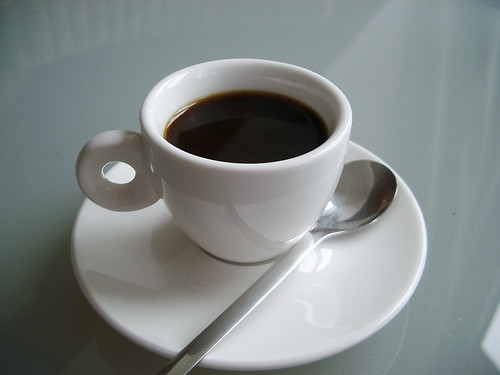
caffè normale - this is what you get when you walk into a bar and ask for a coffee. Also called caffè liscio (straight coffee) or espresso. You enter a bar, say: "Un caffè, per favore". The bar-keeper will ask: "Liscio?" ("Straight?"). This is your last way out of ordering a coffee with some quantity of milk, because you can either say: "Sì" (yes, I want an espresso) or specify any of the milk-coffee versions listed below.

Espresso is not only a tiny cup of very strong coffee. It's made in a specific way: the water is heated up to the point of evapourating in the machine and
pressed through the fine powder. Contact with cold air makes the vapour liquify again. This is espresso. All other Italian coffee types are based on espresso (unlike the French coffee that is based on strong filter coffee that has a different production process).

Espresso is rarely good outside of Italy (except Portugal, where it's better) and it's inadvisable to order some without milk when the quality is not guaranteed. It seems a mystery - even if an Estonian high-end cafeteria buys an exclusive Lavazza espresso machine complete with coffee beans and uses bottled water from the Alps, the espresso will still not taste the same as in Italy. It's simple really: the quality of the espresso depends on the amount of coffees made each day. The more, the better. For this reason the best coffee is often found in railway station bars and not in isolated mountain restaurants.

Espresso is ok to order at any time of the day, though not too usual right before a meal. In the mornings
most people order coffee with milk, such as:

Caffè macchiato (read: caffè mak:iato) is espresso with a little bit of milk. It's still a very tiny cup of coffee for those who don't have time to lose over their coffee but don't want to drink it black either. The added milk can either be cold (caffè macchiato freddo) or hot (caffè macchiato caldo or just macchiato caldo).


Macchiatone is a bigger version of caffè macchiato for those who want to enjoy some more milk foam, but don't want to get a full cappuccino. It still costs the same as espresso (85 cents in the North, less in the South).

Cappuccino (also called cappuccio for short) is served in a cup about the size of a "usual" (Nordic) coffee and is espresso buried in milk foam. This is the ideal morning coffee as it's easy on the stomach and very delicious together with a nice brioche (often filled with cream or marmalade; similar to the French croissant*). But - attention! - cappuccino is ONLY a morning coffee. Having it at any time after 11:00 in the morning will automatically shout of being a foreigner who is not initiated into the Italian ways. The exception can be made if you happen to be an elderly lady and it's a very cold day. The worst that one can do is order cappuccino after a meal. This will make everyone from the waitress to the dish-washer snigger under their breath. Why? Well, having coffee after a meal has a stimulating effect on the digestion that doesn't really work if the coffee is served with a significant amount of milk. It doesn't make sense to add hot milk on top of a full stomach. Exceptions are made for caffè macchiato, however - that's a way out for those who don't like black coffee.

Latte macchiato is not the same as caffè macchiato. As the latter literally means "marked coffee", then latte macchiato is, obviously, "marked milk" - hot milk with a little (half a cup of) espresso. This is not a usual drink for Italians to have in a bar, though at home this can be quite common. A cup of hot milk is a morning classic**; variations include milk with cocoa powder and milk with coffee. Latte macchiato is often intended to be the same as caffè latte that Estonians just call "latte"*** and drink at any time of day. Mostly the difference between latte macchiato and caffè latte is that the former contains half a cup of espresso, poured in after the milk (so there'll be a mark on top of the foam) and caffè latte includes a whole cup of espresso on which milk has been poured. In Italy, both latte macchiato and caffè latte have its specific rules similar to cappuccino.

That's more or less it with the milk. Any of these can also be served with some cocoa on request (this produces even more different names). What comes to coffee itself, there are a number of variations:

Caffè americano - yes! this is it! That's what you need to ask for if you are a tourist in Italy and happen to have had enough of the world-class espresso and would just like to enjoy a cup of "normal" coffee like at home. Only that it will not be coffee like at home. As the only way of making coffee that the Italians recognise
is the espresso-method, your caffè americano will just be espresso with added hot water. Sounds disgusting. Better bring your own pack of Paulig from home and do it the student-way in our hotel-room with a paper filter. Or just cave in and learn to drink good coffee.

Caffè ristretto is a double-strength, half-size espresso for strong men who aren't afraid of a challenge.

Caffè lungo is a 1,5 size espresso. This is what the Portuguese should ask for while in Italy (an Italian espresso is about 2/3 the size of a usual Portuguese coffee).

Caffè doppio is a double-size espresso and will most likely be served in a cappuccino-cup so that the espresso looks sad and lonely at the bottom.

Caffè shakerato is espresso with ice, well shaked. Perfect on a hot day.
Other coffee types exist, of course, but they are less likely to come up during a usual day at your average bar. Knowing the differences between these main coffee types would keep a tourist out of any big-time embarrassment though. Good luck.


* In Calabria (the toes of Italy) a brioche is a large, quite generic bun, often eaten with ice cream. In Veneto, however, a brioche is what the French call a croissant. There will surely be other regional differences too.

** In the morning or before going to bed is also the only time of day when drinking milk is normal. In any case, milk is always served hot and cold milk is something barbaric that only the Nordic peoples know how to appreciate. Neither is milk ever seen on the table during meals, as it classifies as sweet! Estonian (savoury) milk-soup would surely make any Italian sick.

*** This habit of calling latte macchiato "latte" classifies as another of these foreign words that are imported into the language and then shortened for comfort, though in the original language the meaning changes. It's strange, but in any case as long as in Estonia everyone understands what a "latte" is, there is no problem.