Showing posts with label north-south. Show all posts

Friday, 25 January 2008

solidarity wow

The North and South of Italy are at it again: Naples is drowning in garbage and asking other regions to take in their stuff (to be disposed of 1000km from the original place? way to go...). Veneto has refused and not only - the region is financing TV spots in Germany, pointing out that Veneto is not Naples and there are no garbage issues in the North, so as to inform the tourists that otherwise would be scared into going to Spain instead*.

This shows some true Veneto spirit, I must say. In literature or drama, a stereotypical character speaking Venetian dialect is almost invariably a stingy merchant. It's not that far off - the people around here have always found a way to muddle through even in the worst of times and don't look well on others who don't seem to make as much effort. This is where the discord begins: in Venetian eyes the Neapolitans simply don't try hard enough. And when the president of the region is blamed of not being solidary, well, your average signor Toni will not care about not being nice: "Eloora, cosa xé che bisogna fare? Gà da svegliarse fora, no?**"

English Corriere della Sera on the matter

* I'll be thankful for a link to one of these clips. As of today none were to be found online.
** "So what's to it? Gotta snap ou' of it, yaknow..."

Saturday, 5 January 2008

Documentation

When my Italian friends see my Italian identity card, they are positively surprised: I didn't know they give these to foreigners too!

When my Estonian friends see my Italian identity card, they are surprised and say: but isn't Italy supposed to be a developed country?

My Italian identity card is made of paper.

It's nicely patterned, complete with gaps for hair colour, fingerprint and home address. But, effectively, yes, it's a piece of paper folded in soft plastic.

My Estonian identity card doesn't include any of this data, but does include a signature and a smart chip. The chip includes 3 library cards and can be used to sign documents and vote at a distance*.

The interesting part is that though the Italian ID card seems so unconvincing to foreigners, often it is the only identification that people have. Italians make a fuss each time they decide to travel outside the EU and have to apply and pay for a passport. Making a passport costs astronomic amounts of money and/or time. I've even heard of 70 euro for a passport if you want it faster than normal... seems like it might cost less on the black market.

I guess after a while Estonians won't be too attached to their passports either, as all the 10 EU member states who joined in 2004 are part of the Schengen area now. The land and sea borders are already open. The airports will adapt in the end of March when they change to summer season. That's quite convenient, though most of the border guards are relocated for different jobs and the only Estonian non-Schengen border (east; Russia) suddenly has a lot of guards. I do wonder what Czech Republic did with their border guards...


*
the voting business is theoretical - I missed the last referendum because I couldn't install the card reader driver on Linux. I hear it works though.

Wednesday, 2 January 2008

Natale 2

Second Christmas in Italy, and it was as Italian as expected: we decorated our 25-year-old Christmas tree up nicely, ate copious amounts of panettone and relaxed properly. But there's one thing that I still can't get used to - that's the social side of Christmas: the streets full of people and bars finishing all kinds of wine on Christmas Eve. Around here everyone just stays home with family or the respective boy/girlfriend and doesn't get out for seeing people before the 26th unless they're very close friends. In Italy, Christmas lunch is held with the immediate family and subsequent meals with various aunts and uncles, fitting a fair amount of friends and acquaintances in the middle. That's quite a run. Luckily I only have one family to visit. My feeling of being an inward northerner increased with each person Riccardo knew and congratulated. Well, the custom of giving the best wishes ("Auguri!") is usually accompanied by a handshake and this would be perfect for me. I like handshakes very much. Instead, because I'm a girl, I was expected to approach the people with each of my cheeks in turn and imitate kisses. This is an awkward business at the best of times, especially when both kissers wear glasses, but with people I had never seen before... difficult.

Any northerner who has been to Italy is probably quite familiar with the inner fight: is a friendly smile enough? should I shake hands? what if I'm supposed to actually touch faces? which cheek first?! An Englishman trying to go along with the most usual Italian hello-how-are-you kiss looks embarrassingly indecent: instead of performing with lukewarm/friendly affection they actually plant a furtive wet semi-erotic kiss on the cheeks of the unsuspecting Italian (almost always a woman) as though they had lost in the bottle game and had to do it on a dare. It would be funny if it wasn't so sad.

Hugging, the standard greeting in Estonia for friends, is a different issue. Italians might feel quite awkward if someone less than a very good friend would start hugging them all of a sudden. It's not easy to determine where are the limits of the various kinds of greetings, so the only foolproof way is to follow the locals. Lucky that Christmas is over...

Sunday, 14 October 2007

wow! I could vote!

that's right... one of the many elections taking place each year was today and since it's a small, almost a private one (for deciding who'll take the post of the leader of the Democrat party), they let foreigners vote too. Nice, now I have some right to complain about the politics here.

Make no mistake - I don't care particularly much about politics. If anything, I'm annoyed by the duality of everything in Italy and how the right automatically opposes anything the left comes up with and vice versa. If the left is about supporting culture (human rights, helping the poor and whatever), then the right is against it. What would happen if the left would start holding up national ideals, talk about state security and legalizing money laundering*? Would they be stealing Berlusc*ni's agenda?

This duality means that if the parents make their children go to church the children get back at them by joining a communist or socialist party. As it seems, asking around: left is cool because left means intelligentsia, culture, human rights, attention to Burma and whatnot. Right are the yuppies who don't care about anything farther than their own wallet. The youth who listen to reggae are automatically the left. The middle-aged accountants are automatically of the right. I still don't know how to wrap my mind around this concept.

As the government changed one and a half years ago, I started hearing people say that the state TV suddenly has much interesting programs. This was new because the Italian TV must be one of the worst I've ever seen. Why? Because before the change the TV was made for earning. The masses don't care about documentaries, they care about reality shows. So why doesn't the right care about general culture? Answer: because it doesn't earn. This is the most plausible explanation I got out of my friends. And quite an appalling one, too.

It's (still?) quite different in Estonia, where being active in politics is mostly uncool and the uncoolest of all is the left-ish party who likes to call themselves "the centre". In Italy it's possible to hear someone declaring oneself to be Communist and proud of it. In Estonia this would be political suicide. I wish the naive young men handing out leaflets with the hammer and sickle in Padova would ever happen to go to Eastern Europe and try to convert someone. This should be fun...


* as a second thought, I think that's already legal.

Wednesday, 3 October 2007

A small dictionary of coffee

When food is the heart of life in Italy, then coffee might easily be its soul. Coffee is the proper round-up for any proper meal, the centre of any proper breakfast. The fact that most Italians are blissfully ignorant of the delights of fine tea becomes irrelevant in comparison.

In the European countries that miss their own coffee culture the merry-go-round of different kinds of coffee is often reduced for reasons of simplicity, dividing coffee into "normal/black", "with milk" and "latte" (large milk with coffee), leaving the fancy titles of Turkish coffee, espresso, latte macchiato and other such for the few knowledgeable ones. Or the show-offs.

Thus, for all who have ever wondered whatever might be the difference between latte macchiato and caffe macchiato, here is:


A small dictionary of coffee in Northeast of Italy

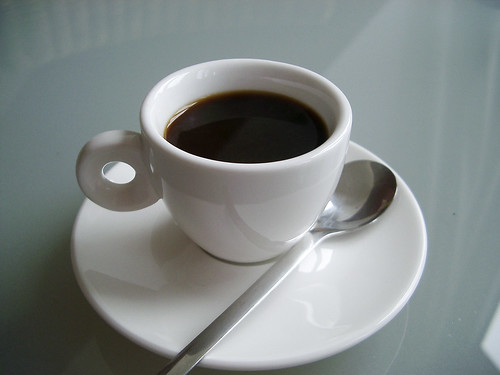
caffè normale - this is what you get when you walk into a bar and ask for a coffee. Also called caffè liscio (straight coffee) or espresso. You enter a bar, say: "Un caffè, per favore". The bar-keeper will ask: "Liscio?" ("Straight?"). This is your last way out of ordering a coffee with some quantity of milk, because you can either say: "" (yes, I want an espresso) or specify any of the milk-coffee versions listed below.

Espresso is not only a tiny cup of very strong coffee. It's made in a specific way: the water is heated up to the point of evapourating in the machine and
pressed through the fine powder. Contact with cold air makes the vapour liquify again. This is espresso. All other Italian coffee types are based on espresso (unlike the French coffee that is based on strong filter coffee that has a different production process).

Espresso is rarely good outside of Italy (except Portugal, where it's better) and it's inadvisable to order some without milk when the quality is not guaranteed. It seems a mystery - even if an Estonian high-end cafeteria buys an exclusive Lavazza espresso machine complete with coffee beans and uses bottled water from the Alps, the espresso will still not taste the same as in Italy. It's simple really: the quality of the espresso depends on the amount of coffees made each day. The more, the better. For this reason the best coffee is often found in railway station bars and not in isolated mountain restaurants.

Espresso is ok to order at any time of the day, though not too usual right before a meal. In the mornings
most people order coffee with milk, such as:

Caffè macchiato (read: caffè mak:iato) is espresso with a little bit of milk. It's still a very tiny cup of coffee for those who don't have time to lose over their coffee but don't want to drink it black either. The added milk can either be cold (caffè macchiato freddo) or hot (caffè macchiato caldo or just macchiato caldo).


Macchiatone is a bigger version of caffè macchiato for those who want to enjoy some more milk foam, but don't want to get a full cappuccino. It still costs the same as espresso (85 cents in the North, less in the South).

Cappuccino (also called cappuccio for short) is served in a cup about the size of a "usual" (Nordic) coffee and is espresso buried in milk foam. This is the ideal morning coffee as it's easy on the stomach and very delicious together with a nice brioche (often filled with cream or marmalade; similar to the French croissant*). But - attention! - cappuccino is ONLY a morning coffee. Having it at any time after 11:00 in the morning will automatically shout of being a foreigner who is not initiated into the Italian ways. The exception can be made if you happen to be an elderly lady and it's a very cold day. The worst that one can do is order cappuccino after a meal. This will make everyone from the waitress to the dish-washer snigger under their breath. Why? Well, having coffee after a meal has a stimulating effect on the digestion that doesn't really work if the coffee is served with a significant amount of milk. It doesn't make sense to add hot milk on top of a full stomach. Exceptions are made for caffè macchiato, however - that's a way out for those who don't like black coffee.

Latte macchiato is not the same as caffè macchiato. As the latter literally means "marked coffee", then latte macchiato is, obviously, "marked milk" - hot milk with a little (half a cup of) espresso. This is not a usual drink for Italians to have in a bar, though at home this can be quite common. A cup of hot milk is a morning classic**; variations include milk with cocoa powder and milk with coffee. Latte macchiato is often intended to be the same as caffè latte that Estonians just call "latte"*** and drink at any time of day. Mostly the difference between latte macchiato and caffè latte is that the former contains half a cup of espresso, poured in after the milk (so there'll be a mark on top of the foam) and caffè latte includes a whole cup of espresso on which milk has been poured. In Italy, both latte macchiato and caffè latte have its specific rules similar to cappuccino.

That's more or less it with the milk. Any of these can also be served with some cocoa on request (this produces even more different names). What comes to coffee itself, there are a number of variations:

Caffè americano - yes! this is it! That's what you need to ask for if you are a tourist in Italy and happen to have had enough of the world-class espresso and would just like to enjoy a cup of "normal" coffee like at home. Only that it will not be coffee like at home. As the only way of making coffee that the Italians recognise
is the espresso-method, your caffè americano will just be espresso with added hot water. Sounds disgusting. Better bring your own pack of Paulig from home and do it the student-way in our hotel-room with a paper filter. Or just cave in and learn to drink good coffee.

Caffè ristretto is a double-strength, half-size espresso for strong men who aren't afraid of a challenge.

Caffè lungo is a 1,5 size espresso. This is what the Portuguese should ask for while in Italy (an Italian espresso is about 2/3 the size of a usual Portuguese coffee).

Caffè doppio is a double-size espresso and will most likely be served in a cappuccino-cup so that the espresso looks sad and lonely at the bottom.

Caffè shakerato is espresso with ice, well shaked. Perfect on a hot day.
Other coffee types exist, of course, but they are less likely to come up during a usual day at your average bar. Knowing the differences between these main coffee types would keep a tourist out of any big-time embarrassment though. Good luck.


* In Calabria (the toes of Italy) a brioche is a large, quite generic bun, often eaten with ice cream. In Veneto, however, a brioche is what the French call a croissant. There will surely be other regional differences too.

** In the morning or before going to bed is also the only time of day when drinking milk is normal. In any case, milk is always served hot and cold milk is something barbaric that only the Nordic peoples know how to appreciate. Neither is milk ever seen on the table during meals, as it classifies as sweet! Estonian (savoury) milk-soup would surely make any Italian sick.

*** This habit of calling latte macchiato "latte" classifies as another of these foreign words that are imported into the language and then shortened for comfort, though in the original language the meaning changes. It's strange, but in any case as long as in Estonia everyone understands what a "latte" is, there is no problem.

Wednesday, 29 August 2007

Once out at the Bay of Tallinn


I had been out of Estonia almost a year. It was great to be back and pleasant to find the people just the same*. A number of strange new houses have been built, there are more types of soviet-nostalgic ice-cream on sale, but apart from this - well, it's enormously comforting to find everything just as it always was. I had enough time to sleep for a week, spend time doing nothing with my mom, read the new Harry P_tter book, visit friends, study some, and host Riccardo - the latter being a demanding task: he had already been in Estonia 3 times before, and we had to go beyond the usual tourist attractions and see closer.

As a part of my family's effort to make Riccardo have fun during his visit we took a ride to Naissaar (an island roughly 10 km northeast of Tallinn) in my uncle's tiny inflatable boat. We packed up the tent, food and beer until it took up almost half of the little boat and set out. The weather had been dodgy all day, but it had cleared up just as we reached the port, and the ride was great fun. The waves weren't too big, but it seemed like a good idea to agree among the four of us that we can say later they were approximately 2 metres or so. As we reached the northern tip of the island the waves rose until they really did seem to be 2 metres high - the stones at the shallow bottom were giving us their greeting this way. The waves closed with a foamy rumble behind us and suddenly one of these reached out over our little boat, the water green against the sunlight. I thought: "Wow..." and felt myself sliding down into the warm water under the overturned boat.

When I emerged and saw the others' heads bobbing around the bottom of the boat my first thought was to gather up as much of the baggage as possible. I grabbed the first plastic bag I saw and heaved it on top of the boat bottom. It was canned fish - I still have no idea how it could float. The only other thing we found was a 5-litre bottle of water (also floating). Nothing else was to be found around. As I sat on top of the boat, trying to pour water out of my sleeves, having water, paddles and canned fish with us seemed to be a poor consolation. I remembered vividly the transparent waterproof bag into which we had packed all phones, car keys and documents - it hadn't been tied to the boat as the tent and food was. I deduced it must have sunk and, between taking turns to paddle ferociously towards the shore, said goodbye to my (already second) brave camera, driving licence, id and everything that would be a mess to reapply, not to mention pay, for. The situation definitely didn't seem serious enough to take on the "earthly things don't matter" stance yet.

When the first surprise had passed and we had congratulated ourselves accordingly for having ended up in a proper modern-day shipwreck (merehäda, literally "trouble-on-the-sea"), my uncle took out his waterproof pouch holding a phone and, calm as if he would be rescheduling a business meeting, called a few of his friends living on the island. "Hey, how's it going? Are you at the island? Ah, too bad, a wave overturned my boat here at the north tip... Yeah, very strange, never heard anything like that around here... Well, I'll just call x then..." Of the people who were in a position to help us from the island most were right at the other side of it, more or less 10 km away. So, instead of making a big deal out of things, a decision was made that a few guys from the north end would come to pick us up in a row-boat.

In the meantime, paddling was serious business. The strong current kept turning us away from the shore, directing back towards Tallinn. There was no way of turning the boat right way up again - even if only half of the things were still latched to it, it would definitely have been too heavy to turn for 2 men and 2 women at open water. Also, this operation would certainly have liberated everything that had still remained inside, so the little hope of procuring our belongings from the sea with no working engine would have been lost. While paddling was doing little to take us closer to the shore (in fact, we seemed to drift farther away with each minute), it did give a sense of purpose to the situation. While wondering how long it could take for someone to set up their boat and reach us, we had time to make an endless series of jokes on how to open a tin can without any tools save a cellphone and a bottle of water; create a keep-warm boxing match and agree on telling lies to any family members until the whole adventure would be safely behind us. It must have been by the end of the second hour or so when we saw a tiny spot moving towards us across the waves.

Our saviour wasn't three men, but one - a stout fellow with the look of a weary old Basset Hound, pulling on the oars of his tiny boat with the impression of being quite somewhere else. Riccardo and I transferred to his white plastic rowboat and, having connected the upside-down rubber boat behind it, pointed ourselves once again towards the shore that wouldn't come closer.

It went on for another hour. I didn't have another chance to paddle and staying immobile soon made my teeth clatter with cold. Waving hands around just to move some part of my body, I listened to my uncle arranging for another boat to come from the other side after all - the current was too strong to row across and darkness would be coming in a while. The sky had turned a brilliant pink, contrasting the sharp outlines of the dark clouds against the sunlight that would soon be gone. It takes time for the night to come in Estonia, but we didn't fancy having to try our luck in the dark.

There wasn't much more to do than wait. Being in trouble didn't seem as much fun as it had before and the pool of water inside my pants was quite cold to sit in. As the twilight started to thicken around us, we finally saw the border guard arrive. They headed for the location we had previously communicated and passed us without noticing. Great! So much waiting and now they don't even see us! It was a relief to see the boat finally turn.

Watching from the warm inside, we saw 3 border guards, my uncle and our valiant saviour finally grab the rubber boat, its propeller still sticking out, and turn it the right way up again. At the moment they had managed it, we saw all the waterproof bags spread around over the water. The blue tubes in which my backpack and shoes were, the black plastic-packed ones with food, the yellow bundles with warm clothes and - miraculously - the tiny transparent package, most important of all. One by one, the closest bags landed in the border guard boat. I remember sighing at the irony of the situation - there it was, while the documents were floating off towards south, and they were saving the beer first...

It took some time for the boat to circle the surroundings and make sure no other bags were left. It seemed unreal - we really hadn't lost anything except some of the boat equipment. I couldn't believe our luck. As we took our course towards the south end of the island, my uncle's phone rang and for the first time it wasn't anything about boats. My mother wanted to know why I hadn't answered my phone for the last few hours. "Ah, well, you know, I switched it off until we were in the boat. We're setting up the tent... Yeah, it's nice here... Hey, I've got to go and help with the cooking, talk tomorrow..." It had been a while since I had told such outright lies to her. But the opposite would have been worse, at least she could sleep that night.

It was a wonderful feeling to set foot on dry land. A friend of my uncle's gave us a sauna and a place to sleep for that night. Arriving to the warm house and starting to unpack all the wet bags felt like being extremely rich. One thing after another that I had already believed lost emerged and I turned random things in my hands, returned to me from under the sea.

The best news of all was a mountain of food that had stayed dry (unlike the clothes). We had an excellent feast and good old traditional ways of warming up – vodka for the inside cold, sauna for the outside one. By that time we were already wondering how much planning it had taken for my uncle to arrange all that and how long should our thank-you letter to Nokia and the Estonian coast guard be. It has been a while since I have slept as well as that night.

But on the other side, I felt it was my duty to thank the sea the old way. It had gotten us in trouble, but also let us go and take all our belongings with us as well. If there is one thing that growing up on an island teaches you, it's that the sea is not always so kind. I bought a bottle of vodka and said thanks at the tip of the farthest peninsula.


* except bj, who I was glad to find looking much happier than before.

Sunday, 15 April 2007

La Quaresima - the veggie story

Religion is not very big in Estonia. Compared to Italy or Poland, that is. The country is predominantly Protestant, but apart from going to church on Easter Sunday there aren't too many people who would be both devoted and open about their religion (it's not socially encouraged - believing is something deep and personal). I did go to Sunday school as a child, but I don't remember much apart from colourful pictures about Moses. Thus I don't really know much about Catholicism either, apart from what I learned in history about the Reformation and all that.

The Lent is a big part of the Estonian religious tradition (in fact, the word for Easter, "lihavõttepühad", literally means "time for taking meat"). But nowadays it's hardly followed anymore. The religious Bulgarians turn vegan for the whole 40-day period. Italians merely avoid eating meat on Fridays. But I couldn't even start to imagine the Estonian way of fasting. I guess one could just make their own rules. Last year Riccardo and I challenged each other to stay away from alcohol during Lent. We did it, but it proved very difficult in societies where aperitives and beers are a social custom. This year we decided to be easy on ourselves: keep the wine, drop the meat.

I've always regarded vegetarians with a kind of reverence for being able to live without meat. Since returning from 3 weeks in Turkey last year with the only wish of never seeing another kebap again, I've started to understand that not eating meat doesn't have to be a mental effort, but could just be a matter of taste. So I welcomed the challenge.

In Italy it isn't very difficult to avoid meat, as every mealtime is divided into two courses: "the first" (generally pasta or rice) and "the second" (meat or fish). Apart from a few exceptions, the pasta is usually vegetarian and it's very easy to be too full to have anything else afterwards. Usually, that is.

The main difficulties occurred in relation to Damiana's (my Italian mom's) wonderful ragù that I had to decline so many times; the tramezzini (soft triangular sandwiches), usually made with various kinds of prosciutto or seafood that are quite irresistible; and canteen-keepers that don't understand the meaning of "vegetarian". Halfway through the Lent I visited a country restaurant with a group of 14 or so. We had ordered ahead - both vegetarian and meat pasticci (the Veneto version of lasagne) that looked tantalising indeed. The food was excellent and everyone quite content until the owner, lured into a gastronomic discussion by one of our companions, revealed his secret: of course I always put sausage in my pasticcio, otherwise it wouldn't taste like anything! I didn't know which was worse - the insult or the feeling of utter stupidity at not having recognised pork in my food. I thought of my dear friend Elina and what a scene she might make in righteous rage if someone set her up like this. And then I thought that I didn't really have a reason to lament, as I'm not really a vegetarian anyway, far from it, and even farther from being a devoted Christian. This, obviously, didn't make me feel any better.

Then there is the occasional unease at having a potluck dinner or shopping for a picnic together with a group. Shopping is exceptionally uncomfortable, as meat products always cost more than everything else and while dividing the bill it doesn't end up fair to the few people who don't even intend to touch the ham. So the choice is between paying (preferred, as it's friends after all) or coming across as overly scrupulous and/or stingy (often the only way for the coin-counting volunteer). I still haven't managed to find a satisfactory way out of these kinds of situations.

Basically any setting where I can't decide on my food is a potential problem. Flying, for example. KLM has solved the issue simply by serving two small sandwiches, of which one is ham and the other cheese. Malev, Hungarian airlines, allows meal-selection on booking and aboard I got a nice special box with my name on it, including a cheese-paprika sandwich and a muesli-snack. On the flights to Istanbul Malev's meals are equipped with a visible 'no-pork' sign, which is nice, but I do wonder about Muslims taking any other flights. Turkish airlines is very nice - they just serve salads.

It's already some time since Lent. In the meantime I've spent a week in Turkey and my meat consumption has probably made up for the whole 40 days of staying without. But there wasn't much to do - some countries are simply not habitable by vegetarians. Last year's 3 meat-packed weeks taught me that unless one wants to survive on peynir pide (cheese pie) or soups (made with meat stock in any case), there is hardly any way (at least for a foreigner) to remain true to one's convictions about meat. Though, of course, no pork is ever served. This is one thing in which I agree with the Turks completely. Pigs, being able to digest anything in a surprisingly short time, seem to be rather nature's clean-up crew (such as wolves) than animals made for eating. Though Italians have turned ham-production to an art with all their prosciutto crudo, salame and mortadella, my first culinary goal will be to avoid pork. Then, maybe, I could start thinking of any other vegetarian distances.

So here I am, a wannabe-ovo-lacto-vegetarian. I don't need meat in food and the Lent did make me feel exceptionally good, but the difficulties of being vegetarian are simply too troublesome for me just yet. I would probaby be able to put up with most issues, if I could install the label of "vegetarian" as a firm part of my identity, such as: Hello, I'm Maris, I'm vegetarian. But until then I'll toddle along with one foot on each road.

Tuesday, 6 March 2007

a secret home

24th February is the Estonian Independence Day. It counts up from 1918, its first ever declaration of independence. Usually what happens is that everyone stays home from school/work, relaxes, watches the military parade from TV with one eye, and then the President's reception ("the penguin parade") in the evening. A casual type of patriotism.

In Italy I didn't do much anything apart from a few long phonecalls home. I guess I could have made my friends eat mashed potatoes and mince-meat sauce with me, but didn't feel the date to be too pressing. Will do later. Independence day is such a casual thing after all.

Then one of the Estonian newspapers published an article claiming that people who spend a longer amount of time abroad will become more patriotic and start to regard their home country as the best place in the world. I found it from Emigrant's blog who had found it from Oudekki's blog. My first thought was to snub the whole thing as just another of the bluntly one-sided claims one comes across in the media. I'm absolutely not going to say that the Estonian rudeness, tiny-country mentality, the President's speech or national sports will start to bring tears to my eyes just because I haven't set foot to the country for the last 5 months. It's two years that I'm in and out of the country for shorter or longer periods. The only pride that I've felt during this time for what one could call the "Estonian mentality" was in Lithuania: there the people were even ruder.

Then I started to think about it a bit more. So what is it really that would make me want to live in Estonia again? Staying abroad does give one an ability to compare and appreciate things for what they're worth; it dissolves the defaults and makes it (sometimes painfully) clear that there are other ways of living than the habitual one. This is how I understood that the sulky waitress that bangs your food on the table after having you wait for 40 minutes is only normal in Eastern Europe; but that being able to use free wireless all those 40 minutes is a rare and wonderful luck. That it's actually possible to go out in the evening without sitting in endless cigarette smoke and having endless beers. And all that.

Of course national identity jumps all the way up on the priority list the moment the person leaves the country. It's no longer obvious where they're from. Every introduction brings up an affirmation to the heritage and becomes a part of: a) how the person perceives herself;
b) how others perceive the person.

Someone who has tried not mentioning their precise country of origin will know what I mean.
A: So, where are you from?
B: Northeast Europe.
(That's never enough, ever, even if A failed geography in elementary school.)
A: Aha, which country then?
B: Estonia.
A: Ee...
B: It's in the northeast of Europe.
A: Aha...
If I decide not to reply, or be vague ("you know, around there, near Sweden"), I'll certainly feel guilty for not admitting to my nationality, and A will feel uncomfortable for not being able to tag a stereotype to me (strangely, this uncomfort doesn't extend to tags that say "country x" or "Estonia" - as long as there is a tag, A will be happy because he'll feel that he knows who he's dealing with).

Repeating this dance every few days will definitely affirm, affirm and keep re-affirming my national identity, even if I eventually might forget the taste of black bread and lose interest in Estonian news. This way, being Estonian has turned into something very personal. Not secret - here I am, tagging "Estonia" to my name with every new acquaintance - but personal in the sense that there are only a few who know more about the country than the name. Who could come close to understanding what makes the place special after all.

There's just no explaining it. If I try to describe what spring is in Tartu, I end up in an incomprehensible rant, substituting missing words with bland clichés. I try to put to words the mid-exam-session feeling of staying up until the wee hours; roaming the streets by night; feeling, rather than seeing, the sun rising at 3:30 am; the feverish energy of not having slept enough; the fresh grass under tired feet; the liberation of yet another exam passing; the blinding sunlight; feeling the city getting ready for summer and sleep.

If someone asks me what I miss, I usually turn it all into a joke and say something small. Good bread. Convenient prices. The culture media. I avoid lapsing into what I really miss. But if I return, it will be for the friends and family. Family and friends. And, charged deep into a known city or landscape, the secure feeling of memory and continuity.

Saturday, 20 January 2007

cheesecake!

During my time spent in Italy I've understood something interesting - even though it can be acceptable to be late anywhere to some extent, it is intolerable to be late for lunch. Food is what one should be on time for, no matter what.

Well Italians are famous for their food. The simplicity, the taste. It's wonderful, and everyone can understand why it's being copied everywhere - even a copied version of Italian food will be good. (This is excluding the pastas boiled for 20-minutes and pizzas made with ketchup, which is another category - una bestemmia, and will be described later.) The way to keep this standard all through the country is a complicated set of rules and categories that any self-respecting Italian will cling to. For example, the strict rhythm of dishes in a meal - pasta first, meat later, and not together, but separately. The all-around ban to capuccino after 10:30 in the morning. The necessity to keep the salty and the sweet strictly apart - milk is sweet, rice is salty, so no milk soups, no rice desserts. Obviously this will become an obstacle while tasting some foreign foods (the Portuguese sweet rice, the Norwegian caramel cheese, etc) and turn to seem stubborn.

Once an American friend of a friend of mine taught me to make the cheesecake. It was the way she was used to making it and it was exquisite. So I've never taken to change the recipe, as it was perfect the way it was. When I took to making it in Italy, it was nothing more than an attempt to make a nice cake for the others to try.

As I mentioned that I want to make a cheesecake, the first reply I got was - but let's make tiramisù, it's much better! When I was looking for Philadelphia cheese in the supermarket, my friend said - but why should you use Philadelphia? Use mascarpone, it's much better. And you know, people won't want to taste the cake if they know it's made with Philadelphia. It's strange, because Philadelphia is salty.

Obviously I was convinced that the sour Philadelphia is what makes cheesecake proper (because mascarpone is rather a texture than taste, and the cream they use here, panna, is rather sweet though used with salty food) and that otherwise it would simply be just an oversweet cake with no special qualities at all. Thus I entered in a series of discussions over what a 'cheese' means (because ricotta is a cheese too, and not salty, and used in cakes), what 'a recipe' means (under which conditions should it be changed), and most of all - what Italians feel about their food.

What Italians feel about their food is most of all security. Things are done in a certain way because this is how they have been for centuries. It is allowed to try strange things, but in any case black bread or other foreign elements will never integrate with a real Italian. Try it - find an Italian that has never lived abroad and had to put up with strange food on a daily basis. Offer this Italian something coming from another country, but something that doesn't have international prestige - nothing like Swiss or Belgian chocolate, that is. Take cookies from the Netherlands (classifies as 'the north', hence means 'bad food'), or candy from an obscure Eastern-European country, and offer these to your Italian as something you seriously consider worth trying. The Italian, being a polite person, will have to accept. He will nibble a little bit off the edge of the cookie or candy, with an expression not unlike one tasting wine, decide on something, and then remark (if it's good): 'ah, si, we have something similar...' or (if it's not good) 'well, hm, it's particular / strange / we're not usually putting these things together this way... Is it typical to your country?'

This trying-session will undoubtedly be the last time this particular thing will be eaten by the Italian. It's obvious. Italy already has everything one needs to eat.

edit: I added the recipe too - Lindy's cheesecake.

Tuesday, 19 December 2006

il nord

The North, seen by the italians, is a concept perceived both in an admiring and a ridiculing way. from one side, The North is a place where all the women are tall and blond, the trains are on time and the politicians don't punch each other in the parliament. the other side is the stereotypes of bad food, the bad fashion and extreme coldness in communication. The North starts from germany towards the north, and the stereotypes are greatly influenced by the germans and british. french are not nordic. the swiss are. norwegians are so nordic that they must be wearing patterned wool sweaters and viking helmets all day, and it's very difficult to imagine.

my brother was visiting me here a few weeks ago. he entertained the italians as the blond 'viking' guy who drank a lot and didn't talk much. by estonian standards he has brown hair, not blond; he didn't drink much at all; and was very talkative. (only the 'viking' part was party correct, as people from the island where we're from, Saaremaa, indeed were pirates once.)

over and over again i find myself explaining to people the difference between public and private context and why the strange nordic estonians, after frowning for weeks, can suddenly turn into the biggest party animals and do everything for their friends. it's just a question of switching from 'public' mode where it's necessary to seem as cool and uninterested in anything as possible, to 'private' mode, where much more is allowed than normally in a mediterranean company. the knowledge that there is fire under the ice might make it easier to endure the formality of usual communication in a nordic country. it takes a lot of time (during which you might stop trying), but once you're considered 'inside', the people will become unrecognisable.

the stereotypes i've encountered vary greatly. often i have to explain, for example:
- why i'm not blond, and that not all estonians are.
- not all estonians act comatose in company (many of them do though).
- a cold room will be cold for both italians and estonians, no matter which outside temperature we are used to (note that cold is supposed to be outside, not inside).
- how the people manage to stay in a straight line in queues.
- how people manage without the bide's (we have showers).
- if we have orange trees / edible chestnuts / lemons / watermelons / grapes / wine (no, we don't).
- if we have reindeers (no).
- how we survive sauna, and that a 100 degrees won't make your blood boil.
- that yes, we eat pasta (but most people don't know how).
- that we don't use the window covers because we're not used to them and we can sleep with light.
- that we don't hate russians, we just think they don't respect us.
- that we speak estonian, which is not russian, and not related to russian, and don't you ever forget that.
- that yes, we drink a lot (must be all the cold and darkness).
- that yes, the women look very nice (but men generally not).
- that we're an independent country.
- that we're not in war (Baltics & Balkans).
- that we're in the EU.

what noone has asked me about:
- how do we survive the -25 C weather (wearing double hats, pants and gloves, drinking double shots of vodka).
- the temporary ice-roads between the islands and the mainland (1m thick ice will carry up to a 1 ton car).
- the wonderful and healthy black bread.
- the white nights - with only 2 hours of twilight between 12 and 2 am.
- tartu.

edit: I'm aware that in the attempt to avoid going into too many details, I haven't given a satisfactory answer to the burning question of the bidé. In fact what I meant was that a shower can be used instead, though, yes, the bidé will definitely be more convenient. It's just one of these things that exists in some countries and not in others, much like the window blinds (tapparelle), pedestrian reflectors (carta rifrangente), or the gesture of taking off one's dirty shoes while stepping into someone's home.

to be continued