Wednesday, 2 January 2008

Natale 2

Second Christmas in Italy, and it was as Italian as expected: we decorated our 25-year-old Christmas tree up nicely, ate copious amounts of panettone and relaxed properly. But there's one thing that I still can't get used to - that's the social side of Christmas: the streets full of people and bars finishing all kinds of wine on Christmas Eve. Around here everyone just stays home with family or the respective boy/girlfriend and doesn't get out for seeing people before the 26th unless they're very close friends. In Italy, Christmas lunch is held with the immediate family and subsequent meals with various aunts and uncles, fitting a fair amount of friends and acquaintances in the middle. That's quite a run. Luckily I only have one family to visit. My feeling of being an inward northerner increased with each person Riccardo knew and congratulated. Well, the custom of giving the best wishes ("Auguri!") is usually accompanied by a handshake and this would be perfect for me. I like handshakes very much. Instead, because I'm a girl, I was expected to approach the people with each of my cheeks in turn and imitate kisses. This is an awkward business at the best of times, especially when both kissers wear glasses, but with people I had never seen before... difficult.

Any northerner who has been to Italy is probably quite familiar with the inner fight: is a friendly smile enough? should I shake hands? what if I'm supposed to actually touch faces? which cheek first?! An Englishman trying to go along with the most usual Italian hello-how-are-you kiss looks embarrassingly indecent: instead of performing with lukewarm/friendly affection they actually plant a furtive wet semi-erotic kiss on the cheeks of the unsuspecting Italian (almost always a woman) as though they had lost in the bottle game and had to do it on a dare. It would be funny if it wasn't so sad.

Hugging, the standard greeting in Estonia for friends, is a different issue. Italians might feel quite awkward if someone less than a very good friend would start hugging them all of a sudden. It's not easy to determine where are the limits of the various kinds of greetings, so the only foolproof way is to follow the locals. Lucky that Christmas is over...

Wednesday, 12 December 2007

The Alps are the limit

I went to Austria last weekend. It's strange to think that Innsbruck is only 4 hours away and I've never taken the chance. The difference between North Italy and Tirol was simply striking: just a few hours of driving had taken me to a place where it snows continually, people make gingerbreads for Christmas, use the sauna and eat heavy breakfasts. The fact that everyone was speaking rich Tirol-German didn't even seem to matter. I felt right at home. There is more cultural distance between Vicenza and Innsbruck than the latter and Tallinn. Who would have thought?

Or maybe I'm just homesick?

We stayed in a bed&breakfast at Seefeld. The house was exactly what one might expect, thinking of the Alps, Austria, the winter. Cosy. Breathtaking view all around. Interiours bordering on kitsch, but somehow sweet all the same with the endless teddy bears, doilies and Christmas decorations. It was almost hobbit-like with all the comfort and tranquility. We arrived late, so the landlady left the keys on the door for us. Just like that!

Here December doesn't mean snow, but fogs. I leave from Valdagno each morning with a clear blue sky and find a dense opaque wall of fog halfway down to the plains. Some of the evenings the visibility is so bad that the only reason I manage to weave my way through the twisting roads is that I know them by heart. Halfway back up again towards the mountains the fog disappears though, and the stars blink down in the cold night. But the winter in Italy is not gratifying. There are none of those rare evenings that make the Nordic winter worthwhile: the ones when it snows slowly and the quiet makes bitter people feel at peace with the world. Instead there are bright days, the bare trees full of persimmons like orange lamps and no real need for a woollen hat. That's obviously very nice, but all this, and the panettone or nativity scenes have nothing to do with Christmas in my mind. I need to stock up on other accessories, such as gingerbreads from IKEA...

I'll be landing in Tallinn at 16.00 on the 27th.

Tuesday, 16 October 2007

Two Italies

or: "Oh, that's all the way down in Terronia, that is..."

Estonia is a small country roughly the size of Denmark. It's possible to drive from one side of the mainland to another in 4 hours. The population is so small (1,4 million) that it is a piece of cake to set up complicated telecommunications-systems years ahead of other countries. Yet there are a few dialect areas and enough differences between different parts of the country to create a system of labelling - the islanders, the yuppies from Tallinn, the hippies from Tartu, the mulgid, the vòrokesed, the setod (the two latter ones have distinct dialects and traditions of their own). If this is possible in a country as small as this, what does it mean for Italy, long, mountainous and historically divided as it is?

Mostly it means that they have a hard time understanding each other. More specifically it means that for example:
- each small town competes with the other small town 10 km away - which is better, Valdagno or Schio?
- the next province is like another world: ah, the veronesi, they're all strange...*
- no-one likes the milanesi because they're city folk
- the north doesn't like the south because their economy is non-existent and they look lazy;
- the south dislikes the north because they work their life away and think themselves better because of it;
- the veneziani call everyone else land-folk, dirty shoes etc;
- the trentini aren't considered Italian as they're too far north;
- the sardi neither - they're too far from the mainland;
- the napoletani must be the strangest of all the Italians, with their passion, good food, dirty city and high crime rate.
And so on and so forth. A few kilometres here or there will change not only the accent, but the dialect to a considerable degree. It's not only the language that is different - it's proper cultural differences we're talking about. Sicily is a mix of local, Roman, Arabic and Normandian cultures. Rome... well, we've all studied that in history. Genovese have their own great sea odysseys. Venice has it's mix of Byzantium merchant culture, Armenian, Austrian and whatever was roaming the Mediterranean at that time, plus the pride of a thousand-year republic throughout the middle ages. Tuscany has its glory of the rolling hills and grape fields as the prototype of the fictional idyllic Italy (while Napoli is the prototype of the fictional non-idyllic crime-infested dirty Italy).

All these differences are to be expected, considering the geography of the country and the long history of each province being governed by its own dynasty. These differences are no laughing matter. The politics is directly influenced by the northerners who would like to separate from the south and roll in the money they think they'd have this way. The south lives its life like years and years before, not hurrying for much anything and will hardly be able to understand the frantic Veneti who work their lives away without (apparently) being able to enjoy it enough. They say that even though the south wouldn't have any public money to manage themselves without the north... but then again, the north wouldn't have any pizza-chefs or barbers without the south.

North and South recalls something I've grown to consider fundamental if one is to understand how anything works in Italy: the underlying duality of everything. Everything. If there is a rule to something, there are also a series of counter-rules and exceptions. It's forbidden to have cappuccino in the afternoon, but it's allowed if it's cold outside or if you're just strange like that, but in any case a macchiatone is better. It's bad tone to let oneself go and be rude to someone without bothering to hide the insult between lines, but it's allowed and completely normal in traffic, but in any case "Lei" (official form of address) rather than "tu" should be used**. And so on and so forth. This is why the foreigners will hardly even scratch the surface when they spend a nice sightseeing week in Italy. As B. Severgnini puts it: there are two Italys. There is Italy - what the foreigners think Italy is like - all rolling hills, wine and small boys with black curly hair; and then there is Italia that is a mess and has nothing whatsoever to do with Italy.


* Venexiani - gran signori
Padovani - gran dotori
Vixentini - magnagati,
Veronesi - tuti mati...
(Venetians - all great lords; Paduans - great doctors; Vicentians - eating cats, Veronese - they're all mad...)

** this would sound like something along the lines of: "You, sir, are the biggest ass I've ever met" or "You, mister, are an unfortunate dimwit". Cursing in traffic often needs to be so fast that no form of address can really be used, in which case everyone understands "Lei" to be implicitly included in the "Coglione!" shouted out the window of a passing car.

Sunday, 14 October 2007

wow! I could vote!

that's right... one of the many elections taking place each year was today and since it's a small, almost a private one (for deciding who'll take the post of the leader of the Democrat party), they let foreigners vote too. Nice, now I have some right to complain about the politics here.

Make no mistake - I don't care particularly much about politics. If anything, I'm annoyed by the duality of everything in Italy and how the right automatically opposes anything the left comes up with and vice versa. If the left is about supporting culture (human rights, helping the poor and whatever), then the right is against it. What would happen if the left would start holding up national ideals, talk about state security and legalizing money laundering*? Would they be stealing Berlusc*ni's agenda?

This duality means that if the parents make their children go to church the children get back at them by joining a communist or socialist party. As it seems, asking around: left is cool because left means intelligentsia, culture, human rights, attention to Burma and whatnot. Right are the yuppies who don't care about anything farther than their own wallet. The youth who listen to reggae are automatically the left. The middle-aged accountants are automatically of the right. I still don't know how to wrap my mind around this concept.

As the government changed one and a half years ago, I started hearing people say that the state TV suddenly has much interesting programs. This was new because the Italian TV must be one of the worst I've ever seen. Why? Because before the change the TV was made for earning. The masses don't care about documentaries, they care about reality shows. So why doesn't the right care about general culture? Answer: because it doesn't earn. This is the most plausible explanation I got out of my friends. And quite an appalling one, too.

It's (still?) quite different in Estonia, where being active in politics is mostly uncool and the uncoolest of all is the left-ish party who likes to call themselves "the centre". In Italy it's possible to hear someone declaring oneself to be Communist and proud of it. In Estonia this would be political suicide. I wish the naive young men handing out leaflets with the hammer and sickle in Padova would ever happen to go to Eastern Europe and try to convert someone. This should be fun...


* as a second thought, I think that's already legal.

Wednesday, 3 October 2007

A small dictionary of coffee

When food is the heart of life in Italy, then coffee might easily be its soul. Coffee is the proper round-up for any proper meal, the centre of any proper breakfast. The fact that most Italians are blissfully ignorant of the delights of fine tea becomes irrelevant in comparison.

In the European countries that miss their own coffee culture the merry-go-round of different kinds of coffee is often reduced for reasons of simplicity, dividing coffee into "normal/black", "with milk" and "latte" (large milk with coffee), leaving the fancy titles of Turkish coffee, espresso, latte macchiato and other such for the few knowledgeable ones. Or the show-offs.

Thus, for all who have ever wondered whatever might be the difference between latte macchiato and caffe macchiato, here is:


A small dictionary of coffee in Northeast of Italy

caffè normale - this is what you get when you walk into a bar and ask for a coffee. Also called caffè liscio (straight coffee) or espresso. You enter a bar, say: "Un caffè, per favore". The bar-keeper will ask: "Liscio?" ("Straight?"). This is your last way out of ordering a coffee with some quantity of milk, because you can either say: "" (yes, I want an espresso) or specify any of the milk-coffee versions listed below.

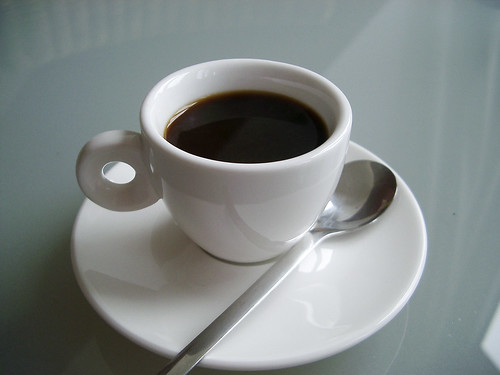
Espresso is not only a tiny cup of very strong coffee. It's made in a specific way: the water is heated up to the point of evapourating in the machine and
pressed through the fine powder. Contact with cold air makes the vapour liquify again. This is espresso. All other Italian coffee types are based on espresso (unlike the French coffee that is based on strong filter coffee that has a different production process).

Espresso is rarely good outside of Italy (except Portugal, where it's better) and it's inadvisable to order some without milk when the quality is not guaranteed. It seems a mystery - even if an Estonian high-end cafeteria buys an exclusive Lavazza espresso machine complete with coffee beans and uses bottled water from the Alps, the espresso will still not taste the same as in Italy. It's simple really: the quality of the espresso depends on the amount of coffees made each day. The more, the better. For this reason the best coffee is often found in railway station bars and not in isolated mountain restaurants.

Espresso is ok to order at any time of the day, though not too usual right before a meal. In the mornings
most people order coffee with milk, such as:

Caffè macchiato (read: caffè mak:iato) is espresso with a little bit of milk. It's still a very tiny cup of coffee for those who don't have time to lose over their coffee but don't want to drink it black either. The added milk can either be cold (caffè macchiato freddo) or hot (caffè macchiato caldo or just macchiato caldo).


Macchiatone is a bigger version of caffè macchiato for those who want to enjoy some more milk foam, but don't want to get a full cappuccino. It still costs the same as espresso (85 cents in the North, less in the South).

Cappuccino (also called cappuccio for short) is served in a cup about the size of a "usual" (Nordic) coffee and is espresso buried in milk foam. This is the ideal morning coffee as it's easy on the stomach and very delicious together with a nice brioche (often filled with cream or marmalade; similar to the French croissant*). But - attention! - cappuccino is ONLY a morning coffee. Having it at any time after 11:00 in the morning will automatically shout of being a foreigner who is not initiated into the Italian ways. The exception can be made if you happen to be an elderly lady and it's a very cold day. The worst that one can do is order cappuccino after a meal. This will make everyone from the waitress to the dish-washer snigger under their breath. Why? Well, having coffee after a meal has a stimulating effect on the digestion that doesn't really work if the coffee is served with a significant amount of milk. It doesn't make sense to add hot milk on top of a full stomach. Exceptions are made for caffè macchiato, however - that's a way out for those who don't like black coffee.

Latte macchiato is not the same as caffè macchiato. As the latter literally means "marked coffee", then latte macchiato is, obviously, "marked milk" - hot milk with a little (half a cup of) espresso. This is not a usual drink for Italians to have in a bar, though at home this can be quite common. A cup of hot milk is a morning classic**; variations include milk with cocoa powder and milk with coffee. Latte macchiato is often intended to be the same as caffè latte that Estonians just call "latte"*** and drink at any time of day. Mostly the difference between latte macchiato and caffè latte is that the former contains half a cup of espresso, poured in after the milk (so there'll be a mark on top of the foam) and caffè latte includes a whole cup of espresso on which milk has been poured. In Italy, both latte macchiato and caffè latte have its specific rules similar to cappuccino.

That's more or less it with the milk. Any of these can also be served with some cocoa on request (this produces even more different names). What comes to coffee itself, there are a number of variations:

Caffè americano - yes! this is it! That's what you need to ask for if you are a tourist in Italy and happen to have had enough of the world-class espresso and would just like to enjoy a cup of "normal" coffee like at home. Only that it will not be coffee like at home. As the only way of making coffee that the Italians recognise
is the espresso-method, your caffè americano will just be espresso with added hot water. Sounds disgusting. Better bring your own pack of Paulig from home and do it the student-way in our hotel-room with a paper filter. Or just cave in and learn to drink good coffee.

Caffè ristretto is a double-strength, half-size espresso for strong men who aren't afraid of a challenge.

Caffè lungo is a 1,5 size espresso. This is what the Portuguese should ask for while in Italy (an Italian espresso is about 2/3 the size of a usual Portuguese coffee).

Caffè doppio is a double-size espresso and will most likely be served in a cappuccino-cup so that the espresso looks sad and lonely at the bottom.

Caffè shakerato is espresso with ice, well shaked. Perfect on a hot day.
Other coffee types exist, of course, but they are less likely to come up during a usual day at your average bar. Knowing the differences between these main coffee types would keep a tourist out of any big-time embarrassment though. Good luck.


* In Calabria (the toes of Italy) a brioche is a large, quite generic bun, often eaten with ice cream. In Veneto, however, a brioche is what the French call a croissant. There will surely be other regional differences too.

** In the morning or before going to bed is also the only time of day when drinking milk is normal. In any case, milk is always served hot and cold milk is something barbaric that only the Nordic peoples know how to appreciate. Neither is milk ever seen on the table during meals, as it classifies as sweet! Estonian (savoury) milk-soup would surely make any Italian sick.

*** This habit of calling latte macchiato "latte" classifies as another of these foreign words that are imported into the language and then shortened for comfort, though in the original language the meaning changes. It's strange, but in any case as long as in Estonia everyone understands what a "latte" is, there is no problem.

Sunday, 30 September 2007

lo spritz

I included spritz in the below right-hand encyclopedia right in the beginning because it's a constitutive part of life in Veneto - it dominates all early-evening drinking activities... well, I mean, usual socialising before dinner.

Spritz is a cocktail that was born in Veneto and is becoming more and more common in the surrounding regions. Inside Veneto, each city has their own version, of which the Venetian one is the most common and Paduan most notorious.

Usually spritz consists of Prosecco (white sparkling wine; in some areas dry white wine is used instead), a dash of sparkling water, ice and Aperol or Campari. Campari is more difficult to drink, so most of the people drink their spritz with Aperol. It makes a bittersweet glass of aperitif, complex to define at once, but easy to drink. It's the default in all bars from 7 o'clock onwards and there isn't a table sitting outside a bar that wouldn't demonstrate a high glass full of vivid orange.

The amounts of wine and Aperol vary greatly from city to city, but usually it would be something like 6cl of Prosecco, 4cl of Aperol and a little water, complete with ice and a slice of orange. A spritz Aperol can cost anywhere from 1.20 to 2.50, but if you're counting cents (or drinking several) most bars will also offer "bianco macchiato Aperol", which is basically spritz without the water and costs less (extra bonus!). In Valdagno this works well, though bar staff is so used to hearing "Aperol" that almost always means "spritz" and will: a) make a normal spritz and charge accordingly; b) make something that's called "spritz bianco" and is just white wine with water - a complete rip-off, considering that the most interesting ingredient is missing.

Paduan spritz, however, is an aperitif to be afraid of: as little as two of these might distract you from having any dinner at all and/or remembering where your home is. As Padua is the city of students, this is often an advantage and warm evenings will find the 4 central piazzas full of buzzing crowds, each person clutching a small plastic cup in their hand, filled with: 1/2 of Prosecco and 1/2 of Aperol and/or Bitter and/or Cynar and/or Campari and/or Gin. The True Paduan Spritz is said to contain each of these (!).

As much as the city authorities (namely those of Padua, but not only) try to impede the masses of spritz-lovers making noise and confusion in the centre, I'm personally not sure that they will have much luck. The appreciation of aperitifs means that all parties start earlier. Mostly, after a few drinks and a good dinner your usual person already feels so content that there isn't much need for more. Drinking full on until the morning (though it happens) is less common here. If the dinner is the centre of the evening, the people will drink aperitifs before, wine during and digestives afterwards, and this can already wrap the evening up quite nicely. Estonians won't believe this, but I've had full parties complete with meeting everyone, hanging around and being silly between 7 o'clock and midnight. Could I be getting old? Anyway, it's the same 5 hours as meeting at 10 pm and keeping on until 3 am.

el rasentin

El rasentin (in Vicenza; in Venice: el resentin) is something so veneto that the whole concept carries with itself an air of mountain huts, of timelessness and of old men hanging out in front of the bars, joking in thick dialect. It's something very provincial and minutely sophisticated at once. Simple, yet genius.

El rasentin cannot be bought in a bar. The drinker has to make it himself, right there on the spot. The old Venetian verb resentar means "to rinse". In fact, making a rasentin is simply getting a shot of grappa after finishing a coffee, using it to rinse the cup and drinking it. It can be any of the various tastes of grappa, but around here plum one is most common. If the cup is still hot and the strong espresso has left some precious foam inside it, the taste of grappa is accented in the best possible way, up to the point of (they say) being truly poetic.

Now this is what I call a lateral approach to coffee...

Wednesday, 19 September 2007

Altavilla

Each morning I take a regional train at 08:01 from Altavilla station to Verona Porta Nuova. Yesterday, however, I was still sitting on the platform at 09:30, waiting for a train that would take me to school. Each of the four train tracks had a stationary train sitting on it for at least half an hour, and all of them were towards east (Venice).

Maybe it was supposed to be a message?

Tuesday, 18 September 2007

cheesecake, vol 2

For the ones who still remember my controversial cheesecake story, and for Liina who needs a permanent place where to find it, here is the recipe to:

Lindy's wonderful cheesecake
(as made in Tartu in 2003, one spring night at 4 am)

The base:
- 200g of cocoa cookies, broken into a powder;
- 150g of butter, melted (or less of it, depends how much you need to make the cookie powder stick, but not too much)
- 2 teaspoons of sugar (optional)

Once the cookies have been reduced to powder either in a bowl (or the student version: in a plastic bag hammered with an empty wine bottle), add the melted butter, stir and place at the bottom of the mould, smooth on top (but not pressed).

The dough:
- 500g Philadelphia cream cheese (not mascarpone!)
- 200g or 1 and a 1/4 coffee cup full of sour cream (in Estonia) or panna (in Italy)
- 1 egg
- 1 small cup of sugar (according to taste, can be less)
- 6 tablespoons of flour + a little vanilla sugar

Mix well in the given order until even, then add to the top of the base.

Bake in an over of 150°C for 30 min (or until about to turn golden on top), then turn off the oven and let the cake sit for 10-15 min for with a slightly open door.

Optional: if preferred, add 75-100g of chocolate melted along with 2 tablespoons of milk on top.

This cake always turns out too small and/or is always finished too fast. It's best when cooled, especially after a night in the fridge. In fact, that one last tiny piece you find in the fridge the next day is the best of all.

Saturday, 15 September 2007

The Mission

I'm currently going through a full-blown blast of eco-friendliness-madness triggered by a nice computer game called Global Warning. This attitude is not new - I've been through this before in various forms. I might calm down again and decide we're all going to die anyway, but each such spur leaves some habits into our household (see the post on M'illumino di meno from February).

Have I mentioned that Valdagno is an excellent place to be an environmentalist? It's an industrial area, so it's definitely not perfect, but the fact that this town was one of the first to start a compulsory recycling system and collect organic waste separately from the rest. I'm immensely proud about it. And equally sad because the municipality doesn't abide to their own rules - the cleaning ladies of the public schools obviously haven't been trained on the recycling system. I've seen them throwing empty bottles and paper all together in a non-recyclable tin.

It works thus: we have 4 garbage cans in our kitchen. There's the glass-and-plastic, the paper and the secco - everything that can't be recycled. And the star of it all is the umido, the organic waste. It's a brilliant thing to separate the food left-overs - it will turn into rich soil in a surprisingly short time, so it can be reused without much effort. The only issue is that the green umido-box needs to be taken out on the street on certain evenings so that the compost truck could take everything away during the night. In the winter it's two nights a week, so if we forget, we end up sitting on a stinking compost box for 3 days (lucky there's the balcony!). Umido is an integral part of our household chores and the one who gets to take it out on Monday and Thursday evenings doesn't have to do the dishes.

The international car-free day is 22 September. In Estonia it gets a decent amount of attention thanks to the work of the valiant Prussakov Bicycle Union . But around here the 22th September takes place significantly more often (how often, really? I've no idea...) as the Domenica Ecologica organised in the whole province at once. Using a car is officially banned inside the towns. Everyone else would get a fine for trying to take their car out of the parking lot, but our GPL-run little Peugeot passes just fine. GPL (liquified petroleum gas) costs exactly half the price of regular petroleum and pollutes significantly less. Riccardo and I drive at least 1,5 hours each day to Altavilla, so it does make a difference. But not every car can be adapted to run on GPL. Even worse, it might happen that the engine is not modified accordingly during the process that will cause ignition problems later. Though I have to say - if it works, it's great.

By the way - taking a bus is out of the question around here - one of the main socio-economical characteristics of the Veneto is that instead of a few big cities it has many small towns, no proper cities and no proper countryside either. Taking a bus from Valdagno to Vicenza is like driving through a 40km city - the bus has to stop on every corner. I take a train from the nearest station, 32km from home.

Then, of course, there is the shopping. We can sort our garbage as much as we want, but eventually it all comes down to what we buy. This is difficult. The eggs are all in plastic packaging - where did the carton go? The local milk-products centre has stopped producing milk in tetrapaks and introduced recyclable plastic bottles instead (yay!). We've started to buy big yogurt packages for eating at home, but for using them for a take-away breakfast the normal small ones are still the only solution. There is only one company ("Sì") that makes yogurt in glass packaging, but it's always sticky on the outside and altogether messy...

The supermarket we go to has introduced bio-degradable plastic bags (yay!), but they are hidden near the cash register and I don't think many people have discovered them yet. It would be such a good idea to price the normal plastic bags from 5 cents to 20 so that people would think about using the bags twice. I'm sure the supermarket wouldn't mind making a little more money... In the meantime I've still got to convince myself to reuse the once-used and weighed fruit-bags another time. Like so many things about saving, it seems a little grezzo - crude.

I'll check out an eco-shop in Verona on Monday to see if they have spray taps and any of those wonder soap nuts that can be used instead of washing powder. It's incredible how many of the usual household chemicals are simply bad for the health, not to mention downright dangerous. Even perfume, technically, should be avoided. But what's the alternative? I guess that's the reason why so many people just don't bother with taking care about what's healthy and what's not. It's too difficult to make sure what really is better and if there are any alternatives to the things people have come to be so used to.

OK, so there is the recycling, the domestic chemicals, the fuel, the excess packaging, the plastic bags. But there was one things i never thought about - indoor pollution from the synthetic carpets and particle board furniture. This is one of the things at which point people say - come on... And so do I - the thought that the nice cheap *KEA cupboard might give me allergies really does bother me. And there's nothing I can do with the moquette either - it came with the apartment. Frustration is still lasting, but I'm waiting to see if the new inhabitants of our home do their job well. As of today, we have:
- one red Kalachoe (Kalanchoe blossfeldiana);
- one beautiful rubber tree (Ficus elastica);
- one heartleaf-philodendron (Philodendron oxycondium)
- two ivy plants (Hedera helix)
- two tiny cactus plants.
We'll see if they can make me stop sneezing.

Now, all this might seem quite scary right now, but I can assure to be perfect normal in a few months and pour chlorine bleach down the tube like any other person. We'll see.