Friday, 26 December 2008

Traffic accidents, earthquakes, snow storms and other presents

Life is going on quietly here. Everything has been smoothly going along towards Christmas, and now along towards New Year. Nothing much is going on, except the other day one guy ironed my car well along the left side, then another one of these days there was an earthquake and I felt my desk swaying as if on a boat, this morning I woke up with Valdagno dressed in a thick snowy blanket, and from 2009 I'll be changing my job, home and flatmates.

Is there something that won't change? No idea. I guess I should just change the haircut as well and have done with it.

Saturday, 15 November 2008

There she is!

You know that one slow driver that always magically happens to get stuck in front of you on roads where it's impossible to overtake? It's an every-morning tradition to guess which kind of a car it will be this time (usually a lorry, but it could also be a perfectly good BMW that just doesn't seem to be able to accelerate). I drive 40km to work each morning and I know the road by heart, most of it is either too narrow or too heavily trafficked to allow any overtaking at all. So I need to resort to all kinds of shortcuts, parallel roads, village and fieldside roads to avoid The Slow Car. Up to now I had always thought of the Slow Car as a car rather than a person, but now I finally met the Slow Person, too!

One gloomy rainy morning, waiting for the lift, I found next to me a 50-ish lady, well dressed, wearing a heavy mask of make-up and an expression that was obviously too naive for her age. She decided to pick up some conversation:
S: "Such a horrible morning, isn't it?"
m: "Mhm."
S: "Yes, and the traffic is terrible!"
m: "Mhm." (Indeed it was, I had suffered for 15 minutes behind a car that couldn't read the road signs and went along at the speed of good 40km/h until I couldn't take it any more and blew the horn to make the car wake up or pull over. No reaction.)
S: "And the people get so vexing too on days like this, they keep making such rude gestures at you when you're not fast enough! Ah, there is no patience in the world!"
m: "Mhm..."

Tuesday, 21 October 2008

Roma

I wonder - if all roads go to Rome, how can one get out?

Tuesday, 14 October 2008

tutta sola soletta

Being home alone is generally a good thing. Nibble instead of proper dinner, watch silly movie, no conversation. Except when being home alone is because flatmates are:
a) in Petra, Jordan
b) in Sofia, Bulgaria.

Feeling a little pathetic and quite envious. Should eat something heavy, but fridge empty. Might watch Bridget Jones to top it all off.

Friday, 3 October 2008

The delights of Mom and Dad

Choosing a supermarket depends on a lot of things, but not so much on the prices or quality of the merchandise. I think the first thing is the parking lot. Then the exposition. And then, brace yourselves, you Northerners, because in Italy (or at least in the Veneto countryside, dunno..) grocery shops are closed on Wednesday afternoons on account of being open all day (can you imagine, all day without a lunch break?!? oh, hang on - yes I can...) on Saturdays. The trouble is that Wednesday is usually when the weekend shopping starts running low on essential provisions, so it's always that day I invariably find myself in front of a closed supermarket. Famila is  the only one that is open that night, so this is where I go.

Today I checked the "magic points" account on our Famila fidelity card. Apparently we've spent at least 2500 euro on our shopping this year, each worth a point. The "magic points" will cancel themselves sometime soon, so everyone is invited to use them on wonderful presents proposed by the supermarket. There's this little catalogue and everything, divided into sections: Presents for Mom, Presents for Dad, Family vacation, and so on. 

Family vacation would be interesting, because they offer ski passes as well, though for the season 2007/2008, so who exactly do they think they are kidding?

Presents for Mom is what one would expect - pots, pans, mugs and stuff for the kitchen, all for an excessive amount of "magic points" to be spent. What I did not expect was Presents for Dad. What would you think would be a present for dad? A drill, maybe? Well, there was a drill. One. Then, apart from that one drill that apparently will be the peak of Dad's commitments around the house, there is: a camera. Apparently only Dad is able to operate this highly complex piece of equipment. Then there is a printer for printing the high-quality colour photographs of the family. Again, for Dad, who is able to use it because he has a computer at the office, but Mom doesn't, because she probably does not go to work on account of being committed to her family. OK, this would all be very well, maybe the nice marketing folks at Famila simply didn't know where to stick the silly little camera and I'd simply be getting all indignant for nothing. 

But. 

The third, most distinctive Present for Dad is a rocking chair. A nice, well-studied rocking chair for Dad to relax in while Mom is cooking in the kitchen. Mom won't have time to use the chair, because she's too busy. Dad, however, has worked all day to provide a living for the family so he will need a good rocking before dinner.

I really have no idea what to choose for my 2500 magic points.

Monday, 22 September 2008

L'autunno

It got cold so suddenly that it only took a day to pass from sandals to woollen sweaters. I shuddered along for a week before giving up and bringing down the winter archive. There are still things in there that I'm unlikely to ever need in Italy - the scarf I made especially for the piercing winds of Vilnius; double mittens that don't need to be taken off for anything; and the only hat in which to handle -20C. That hat is so thick it would qualify as a helmet, and it's also somewhat of a social experiment, because I used all my leftover yarn on it without much regard to the colour effect, and as a consequence I've had more than just a few people laughing behind my back on trains. It does make me look quite silly, especially when the earflaps are tied down, but that doesn't really matter, because I've seen that hat freeze over stiff and still be warm inside. I'm saying it's highly improbable that I might need all this equipment here, but you never know. My room is already improbably close to the freezing point, so maybe this will be the first true winter?

Monday, 15 September 2008

where I come from the things are different

Things are getting stranger.

A few weeks ago in Bremen:
A: No wonder the Germans look ill, see what they have on the menus here!
me: Yeah, but it's not only Germany that's like this, we have something similar going on...
A: No, that's not true! OK, the gnocchi is not the most healthy, but pasta is alright, don't you think?
me: Sure, except I meant we in Estonia...

Somehow the people I know don't seem to register my saying "da noi" or "at our place" as talking about Estonia any more, but about Veneto. Am I finally being taken as domesticated?

Oh well, let's get out with it then

Rather than post any pictures where it would be impossible to deny the apparent lack of looks on my part, I'll just offer a through-the-years perspective from when I was younger.

Create your own at www.yearbookyourself.com

Wednesday, 6 August 2008

A very small survival guide to Veneto. Vol 5 - communication

Eveliis asks:
5. Is there any hope of communicating in English? What should I know in Italian for getting by?

It's possible, it just requires an occasional body-language conversation here and there. In the touristic places such as Rome and Florence you shouldn't have big problems. If you're in town X, however, try your luck with younger people who are more likely to understand you, even if they might not be able to respond. One good thing to be said is that the people who don't speak any English act it out as a shortcoming on their part as opposed to accusing you of not learning their language.

Many Italians will simply speak very loud and clear Italian at you, hoping to make you understand (you'll likely want to comment that you're not deaf or stupid, just foreign, but that will hardly help). They also usually understand complicated written English quite well even if they have never studied any (Latin heritage, lucky bastards!).

What comes to a short Italian course, the ones in the back of the Lonely Planets are usually enough. If you're a fan of full immersion language learning, get a phrasebook and just start talking, however wrong it might come out. It will be appreciated in any case.

If you're not ready to learn anything else, here is what you need to know and repeat many times:
Grazie! (thanks)
Grazie mille! (thousand thanks)

if you're ready for a little bit more, then:

Ciao / Salve (informal/formal, used both for hello and goodbye)
Buongiorno (good morning/day; used for hello, but also goodbye)
Buonasera (good evening; used for hello, but also goodbye)
Mi scusi... / scusa (excuse me; formal/informal)
Arrivederci! (goodbye)
Piacere! (nice to meet you)

Basically, if you say these and smile enough (especially you, Eveliis!), I'm sure you'll be fine.


Up next: What's not worth it? Like, the dirty canals of Venice, maybe...

Tuesday, 29 July 2008

A very small survival guide to Veneto. Vol 4 - tipping / coperto

Eveliis asks:
4. What's the deal with tipping?

Tipping is easy. It's included in the bill and there's no choice involved. The service fee is called "coperto" which basically means everything that covers the table apart from food. It'll be somewhere around 2-3 euros, though in tight tourist spots such as Venice it can be much higher than that.

Il coperto is applied only when you're eating a proper dinner. That is, not in the office-quarter trattorias that offer quick pasta at lunch hour, nor in sandwich bars. But anywhere where you have a tablecloth, a waiter and a menu with abundant choice you can be sure the final price will be a tad above the expected total. The price of the coperto will be written in tiny letters in the bottom of the last page of the menu.


Up next: 5. Is there any hope of managing with English?

A very small survival guide to Veneto (for ignorant northerners). Vol 3 - The Rhythm

Eveliis asks:
Where can I get pizza and drinks at 1 am?


You can't.

There is a rhythm and order to doing things in Italy, and eating has the strictest rules of all. You'd better follow them if you want to play along.

You shall have breakfast from 6 am to 10:30 latest, and the breakfast will consist of coffee and pastries or cookies. No ham. You might get some yogurt if the hostel is in a good mood, but forget about savoury sandwiches - their turn comes later. It's not the time for ham sandwiches yet before 10:30. You're in Rome, so you'll eat as the Romans do.

You shall have lunch from 13:00 to 14:30 latest, probably a little later in the south than north, but it will be a nice healthy meal because at 16 everything will be closed and the most you'll be able to find will be a sandwich or ice-cream. What is this about a five-o'clock dinner? Are you foreign or what? This is not how things are done here.

You shall have dinner anytime from 19:30 to 22:00, probably later in the south than north, but the kitchen will definitely close around 23, and it's not only because it's not healthy to eat this late - it will be because all Italians know it's not and everyone will have their supper on the proper time. There's simply no demand for pizza at 1 am.

Oh, and no cappuccino after dinner. It'll ruin everything.

Now, this applies for real Italian cities where things still work the Italian way, and not the multicultural centres where there are so many tourists asking for absurd food in the middle of the night that there might actually be someone who offers. In Rome you might find pizza at 1 am, but it will be far more likely to find a kebab at 1 am, or any other kind of foreign food, because as I said, the rules are rules - everyone knows them, everyone follows them. The stereotype of rule-breaking Italians is a silly myth. There are rules that are suggestions, and then there are rules about food, dress, family and everything that is important in life that are followed with such care that they become the only way of doing things. The timing of food is one of these.

You might call it alimentary fascism - I know I did for a long time - but in reality it's a part of the culture and why the food is so good and why people around the world are trying to copy it. And - let's face it - it's also a part of the reason why you're coming to Italy.


Up next: 4. What's the deal with tipping?

Sunday, 27 July 2008

Thiene, 27.07.08

Oh, and today I went to see otherwise quite normal people throwing themselves out of a plane at the height of 4500m. I won't lie to you either - the best part was being able to stay in my seat and come down with the plane, though not a whole lot slower than the others.

I guess it's just an idea to get used to. It didn't seem all that scary either, at least before it didn't. Now I think someone will have to push me out once I'm up there.

Sunday, 20 July 2008

A very small survival guide to Veneto (for ignorant northerners). Vol 2 - bringing stuff back


Eveliis asks:
2. What should I bring back? How much should I pay?

The souvenirs are a trap if they're a social obligation, especially for the people who don't travel often. You need to bring back something for everyone, and I mean EVERYONE - the friends, the family, the lady at the bakery, the neighbour, the neighbour's cat. This is where you'll need a lot of something that doesn't weigh, cost or occupy a lot of space, so that you can fit in everything you're bringing back for yourself (the things that do cost, weigh, and take up space). It's a lose-lose situation though. For you, who'll have to hunt for stuff, and for the people back home who probably wanted something more expensive anyway.

The best thing to buy and take back is the food, obviously. Make a round of the cheese counter and you're all set. (Except in the summer that's a bit problematic.) The chocolate is not bad. Pesto is not bad either, though it's readily available for triple price at any Estonian village shop nowadays. It might be an idea to get some key ingredients and cook an Italian meal back home instead of buying overpriced bric-a-brac off tourist streets.

Then there are all the wines, Limoncello, Biancorosso and grappa - that's mostly what takes up all the space in my bags when I go home. You can buy all the wine you like - even really decent ones will still cost less than a crappy bottle of your average red back home. The problem is carrying them, and fitting them in your luggage, and getting them home safely. Some bottles are always in order though. Very generally in the north the white wines and Prosecco (that's Italian champagne, except that it's better than champagne) are best, in the centre it's the reds and the very south has some of the best liquors around and the wines are usually quite strong.


(The only thing that you can honestly forget is any form of bread. That's something that Italians just haven't figured out yet.)


About the prices: if you really want to save, you need time for checking on the same kind of things in a few shops and then go back to the cheapest one.
That's pretty much the only way. Many of the tourist shops count on the see-grab-pay-run tourists that desperately need gifts to bring back for all their friends, so the prices differ considerably. In any case, bargaining is usually NOT in order. It's possible, but I've only ever seen it happen once here - it was a true masterpiece, that scene, but I don't think a foreigner like myself could ever get away with anything like that.

In short - if you need to get something to bring back, best get some food - that's always authentic. If you need something for yourself, well, there isn't really anything you absolutely have to buy.
Some general shopping for quality shoes is great around here though, except I imagine that is sure to burn your budget quite quickly. Anyway, the tourists' now-or-never attitude to buying stuff is what takes the fun out of the whole thing. Just take it easy. What's the worst thing that can happen if you just enjoy yourself and don't worry about shopping?

Up next: Where can I get pizza and beer at 1 am?

Monday, 14 July 2008

A very small survival guide to Veneto (for ignorant northerners). Vol 1 - transports and traffic

When friends of mine plan to visit Italy (but don't come to stay with me), I invariably take up the valiant role of interactive guidebook. I'm happy to: where else would they get custom information on all the Italian peculiarities from an Estonian point of view? Only that my Estonian point of view is not so Estonian any more, and my expertise more or less finishes at the borders of Veneto. I'll do my best though, and this time I'll write it down for next time. This is what Eveliis had to ask:

1. What's the deal with the transport? Trains? Scooters? Police? Is it really as crazy as everyone thinks?

Yes. The traffic is quite crazy, though for various reasons. Mostly, in all Italian territory it's just a little more lively than someone from North Europe would expect. It gets slightly more irregular towards the south, though the worst are the big cities - not because they're Italian, but because they're cities. I wouldn't suggest anyone uninitiated try driving in Naples...

By car:
In any case - Italians are good drivers. Most of them are, at least, and all of them consider themselves exceptionally good drivers, so speed limits and other such mundane affairs are more suggestions than actual rules. It would be an insult to an Italian driver's intelligence to make him/her drive exactly 50 km/h, no more, no less. Where's the romance in that? And it's not about speeding, either. It's about choice.

By "lively" traffic I mean that certain things are (socially, not legally) accepted in Italy that one might not try elsewhere, such as short-time parking in strange places, overtaking in the improvised middle lane, flashing headlights for communicating police presence or telling the slow car to get off the fast lane, etc. However, there are regional differences and best is just to say safe even if it means everyone behind you will hate your going too slow. It's especially useful to stay alert to modest little signs saying "controllo elettronico di velocità" which means, though not always, that there are speed cameras around.

What comes to the driving licence, you can use any EU one in Italy even long-term without any issues, though you should attach a version in Italian (just a small list to know which one is the expiry date and so on). The local driving licence system includes a point system: 22 points for each driver, of which some will be docked at every misbehaviour, double for a new driver, and if you run out, it's the exams all over again. This does not apply to foreigners yet, though I'm sure the carabinieri will have a way of making up for this little problem, such as giving you a higher fine or so on. Speeding up to 10 km/h over the limit isn't punishable, but more than that can cost a lot.

The Estonian police is much more strict on alcohol and driving, and for a reason, because the problems are much more evident. In Italy, where a glass of wine with dinner doesn't stop anyone from driving home, you should be ok with a little beer or wine, though I hear the times are changing here as well and the sanctions are going way up. The legal limit is 0,5 g/l.

The traffic signs are to be evaluated one by one. A small metal sign on a post somewhere is not necessarily the absolute truth, so you'll have to figure out it's true meaning. Italians do. For instance, a delightful example of Italian reasoning by B. Severgnini goes something like this: there's a red light. For most this will mean: stop. For Italians it's a call for discussion. What kind of red is it? Is it a speed-triggered red? Well, I'll go slower, so I could maybe pass. Is it a pedestrian red and the little old lady already passed? Well, I can pass then. Is it a dangerous crossing? I'll better stay put. OK, in any case it's still better to stop. But the temporary signs that are often left at the roadside months after all the digging is done, well, nobody really pays attention to those. In this case you should just see what everyone else does. Careful, though. Even if in Naples people will shout at you for stopping at a red light, it's safer to follow the rules as they are made.

There is a reason why Fiat produces tiny cars: the roads in historic city centres and in the countryside are often made for 1,5 cars, not 2. On roads that would have one-way traffic in Estonia, there is double parking and both directions. Not much room for cyclists. Not much room for big cars. You might get away with a suburban family car, but better fold your mirrors.

By bicycle:
Get a life insurance. Think well. If you still decide to do it, use the smallest roads possible, wear a helmet and reflectors.

Seriously, I really don't fancy going around by bike here. On the 70-limit country roads with considerable traffic you'll have to use the very last millimetre of paved road on the right-hand side and hope the cars don't push you off. Also, most of the roads are either uphill or downhill so it all becomes a little too exciting. As a driver I hate every last bolt on these bikes, especially when I happen to be behind one on a steep mountain road, not being able to get in second gear, but not being able to overtake either. It's torture both to the cyclists and the drivers.

By scooter:
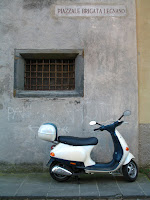
The Vespa is Italian. Do I need to say more? In the historic city centre a scooter is the best way of getting around. It's still quite dangerous because the cars are not likely to consider you, but parking is easy and the rush-hour traffic will hardly go much faster than a scooter anyway.

Outside the cities it's a different matter. It's great to buzz around the country lanes and see places you'd never notice if travelling by car, but any roads with constant traffic are just as dangerous as for the cyclists.

By train:
Trains are good. At least in Veneto they are also mostly on time, so nothing much to worry about. You can check www.trenitalia.it for timetables and prices.

The various types of trains are:
R - reg - regionale - the local and cheapest trains. Most likely to be late because stops at every village station and might have to wait to make faster trains pass.

IC - intercity - faster trains, though not always more clean or comfortable than the regional ones. Drinks and snacks aboard and the staff will try to compensate for missing air conditioning if it should break. It's possible to book seats when paying extra, so if you're unlucky and happen to choose a booked car someone will invariably come and shoo you off your (his!) place. Better change the car when that happens and hope for better luck (I've yet to figure out a way to identify to booked train cars from free ones).

ES, CIS, etc - eurostar, cisalpino and other - the coolest, fastest and most expensive trains. Theoretically should never be late, everyone has booked seats, there are power outlets for your laptop (the Italian ones with three holes, obviously) and other comforts.

AND don't try to get smart with the tickets. It doesn't pay. In the regional trains they check the whole train once in the beginning, but in the more expensive ones the guy in the green Trenitalia uniform will pass through after each stop. The fines start from 25euros and the "stupid foreigner" routine went out of fashion decades ago, so don't even try. The smallest possible punishment is having to buy the train ticket right there from the controllore, except it will always cost 8 more euros.

You can get your tickets either online (printed confirmation code will do), from the automatic ticket machines in the stations (best, also has English) or the ticket booths. The latter will be best if you're really not sure where you're going and how to get there, but the lines are always long, so the machines are better. You should validate your ticket once you have it, either right at the machine or one of the small yellow boxes along the walls, exactly like for city transport. An unvalidated ticket means you could use it again any day, so it doesn't do much to help your cause if you get caught with a nice fresh ticket you just bought. In the south of Italy if the yellow validating machines are all broken you are allowed to write the departure time and date on the ticket yourself and you'll be fine. In the north that doesn't go down at all. If you can't validate your ticket, you should go to the head of the train and explain when you get on board.

Also, try to remember which is the central station in the city you're going to. Other ones, even if they have the name of the city, might not have much to do with the centre at all.

By thumb:
Forget about it.


Next: 2. What should I bring back? Which are the must-be souvenires? How much should I pay?

Saturday, 7 June 2008

Sunday, 11 May 2008

buried in an offline computer

I thought I had all the time in the world to present my tiny master thesis by the beginning of June. This was until Friday. Up to now I'm 8 good pages ahead, but still nowhere near on schedule. Got to get used to rejecting evening meetings, movies and long dinners: the circadian rhythms are so much stronger here in Italy that it's impossible to work around the clock. It used to be so easy in May.

I'm still having some trouble creating connections between work and study - now, finally, they're both in the same area, but I still haven't got a clue how a good theory is supposed to be practical. I can go on for hours on discourse analysis and other such nonsense, but it doesn't seem to matter much. Theories, even if directly about my job, seem to be something I should know about, but only as a background to everything else. It's like the first-year general exams that one has to pass in order to be properly initiated, though it doesn't have any connection to the following studies and no-one will ever know if you remember anything or not.